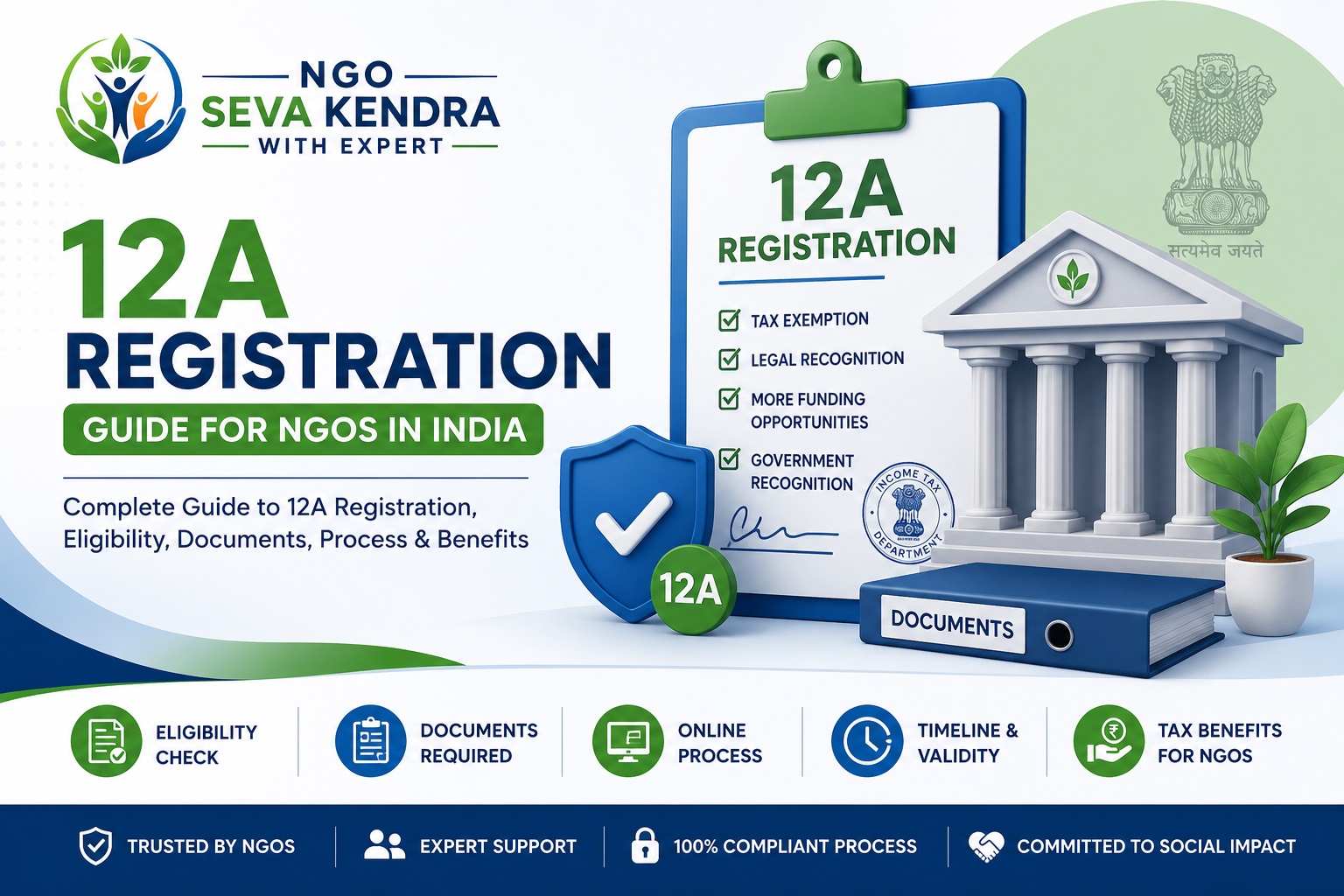
Complete Guide to 12A Registration, Eligibility, Documents, Process & Tax Benefits
Understand how charitable trusts, societies and Section 8 companies can obtain income-tax registration and become eligible to claim tax exemption on qualifying income, subject to applicable conditions.
Quick Summary
| Particular | Details |
| Purpose | Registration with the Income Tax Department for eligible charitable or religious organisations |
| Who Can Apply? | Eligible trusts, societies, Section 8 companies and other qualifying institutions |
| Main Benefit | Enables eligible organisations to seek exemption of qualifying income under the applicable provisions |
| Application Mode | Online through the Income Tax e-Filing Portal |
| Earlier Form | Form 10A / Form 10AB under the Income-tax Act, 1961 framework |
| Current Framework | New applications from 1 April 2026 are governed by the Income Tax Act, 2025; the applicable form depends on the type of application |
| Documents | Registration documents, governing instrument, PAN, accounts and activity-related documents, as applicable |
| Validity | Depends on the type of registration/approval granted and applicable law |
| Processing Time | Depends on the application type, documentation and Income Tax Department processing |
| Important | 12A registration does not automatically mean every receipt or income is tax-exempt |
Important: The terminology “12A Registration” is still widely used when discussing NGO tax exemption. However, the applicable registration framework and forms have changed over time. For fresh applications filed from 1 April 2026, the Income Tax Department’s new framework under the Income Tax Act, 2025 should be followed.
Introduction
Running a charitable organisation involves more than carrying out social welfare activities. An NGO must also maintain proper legal, financial and tax compliance to build credibility and operate effectively.
One of the important income-tax registrations for eligible charitable and religious organisations is commonly known as 12A Registration.
The registration is associated with the provisions governing exemption of income of charitable or religious organisations. Under the earlier Income-tax Act, 1961 framework, registration under Section 12AB became the relevant registration mechanism for claiming exemption under Sections 11 and 12.
The Income Tax Department states that registration is required for eligible trusts or institutions seeking exemption under the applicable charitable trust provisions.
For organisations starting their activities, the current application process should be checked against the applicable provisions and forms under the Income Tax Act, 2025, which came into operation from 1 April 2026.
In this guide, we explain the concept of 12A registration, eligibility, documents, application process, benefits, common mistakes and the relationship between 12A and 80G.
What is 12A Registration?
12A Registration is the commonly used term for income-tax registration obtained by eligible charitable or religious organisations so that they can claim the tax benefits available under the applicable provisions governing charitable or religious institutions.
Under the Income-tax Act, 1961, Sections 11 and 12 provide exemptions for qualifying income of charitable or religious trusts and institutions when the prescribed conditions are satisfied. Section 12A lays down conditions relating to registration and other requirements.
The registration process was subsequently brought under the Section 12AB framework.
In simple words:
If an eligible NGO receives donations, grants or other income while carrying out charitable activities, registration under the applicable income-tax provisions can be an important part of its tax-compliance structure.
However, registration itself should not be understood as a blanket exemption from all taxes or on every type of income.
The organisation must continue to satisfy the applicable conditions, maintain proper books and records and complete the required tax and compliance filings.
Why is 12A Registration Important for NGOs?
An NGO may receive funds from multiple sources, including donations, grants, contributions and programme-related receipts.
Without proper tax registration and compliance, the organisation may not be able to claim the tax treatment available to eligible charitable institutions.
12A-related registration can therefore help an eligible organisation establish a formal tax-compliance framework.
Key reasons include:
- Recognition within the income-tax compliance framework
- Ability to seek applicable exemption on qualifying income
- Better financial and tax compliance
- Improved credibility with donors and institutions
- Greater preparedness for institutional grants and funding
- Proper documentation of charitable activities
- Better long-term financial planning
Who Should Apply for 12A Registration?
12A-related registration may be relevant to eligible organisations established for charitable or religious purposes.
Depending on the applicable legal framework and circumstances, this can include:
1. Charitable Trusts
Public charitable trusts carrying out activities such as education, healthcare, poverty relief, social welfare and other charitable purposes.
2. Societies
Societies established for charitable, educational, social welfare, cultural or other qualifying public-benefit purposes.
3. Section 8 Companies
Non-profit companies incorporated under Section 8 of the Companies Act, 2013 for charitable or other qualifying objectives.
4. Other Eligible Institutions
Other institutions that fall within the applicable provisions and satisfy the prescribed conditions may also qualify.
Eligibility should always be examined based on the organisation’s legal structure, objects, activities and applicable tax provisions.
Eligibility for 12A Registration
Before applying, an organisation should ensure that its legal documents and activities are aligned with its stated charitable or religious objectives.
| Eligibility Requirement | What It Means |
| Legal Existence | The organisation should have valid registration/incorporation under the applicable law. |
| Charitable or Religious Objects | The governing documents should contain eligible charitable or religious objectives. |
| Genuine Activities | Activities should be carried out in accordance with the stated objects. |
| Proper Documentation | Registration certificates, governing documents and supporting records should be available. |
| PAN | The organisation should have a valid PAN and appropriate income-tax records. |
| Financial Records | Existing organisations should maintain proper books, accounts and supporting records. |
| Compliance | Applicable income-tax and other statutory requirements should be followed. |
| No Private Benefit | The organisation’s income and assets should be used in accordance with applicable charitable-purpose conditions rather than for prohibited private benefit. |
The exact documentation and conditions depend on the organisation’s structure and the type of application being made.
Documents Required for 12A Registration
The exact documents can vary according to the organisation’s structure and application type.
Commonly required documents may include:
Basic Documents
- PAN of the organisation
- Registration Certificate / Incorporation Certificate
- Trust Deed, Memorandum of Association or other governing document
- Rules and Regulations / Bye-Laws, where applicable
- Details of trustees, directors, office bearers or governing members
- Address proof of the registered office
- Authorised person’s details
Financial Documents
For organisations that have already been operating, relevant financial information may include:
- Annual accounts
- Income and expenditure statement
- Balance sheet
- Details of income and expenditure
- Relevant income-tax return records
- Audit reports, where applicable
Activity-Related Documents
Depending on the case:
- Note on activities
- Details of charitable activities undertaken
- Photographs or supporting evidence of activities
- Details of donations or grants
- Details of assets and liabilities
- Other documents requested by the Income Tax Department
The Income Tax Department’s published guidance identifies documents such as the governing instrument, registration with the relevant authority, modifications to objects and prior-year accounts/activity notes among the supporting information that may be required under the applicable registration process.
12A Registration Process
The application is made electronically through the Income Tax e-Filing system using the form applicable to the organisation and type of application.
Because the tax framework changed from 1 April 2026, the exact form should be determined based on whether the organisation is seeking provisional registration, registration after commencement of activities, renewal or another applicable approval.
For fresh provisional applications under the Income Tax Act, 2025, the Income Tax Department currently provides Form 104 for the applicable provisional registration/approval process.
Step 1 — Check Eligibility
Review the organisation’s legal structure, objectives, activities and tax status.
Step 2 — Obtain and Verify PAN
Ensure the organisation has an active PAN and that the information available on the Income Tax e-Filing portal is correct.
Step 3 — Prepare the Documents
Collect the governing documents, registration certificate, PAN, financial statements and activity-related documents applicable to the organisation.
Step 4 — Review the Objects
Check whether the objects stated in the Trust Deed, MOA, Rules or other governing document properly reflect the organisation’s actual charitable activities.
Step 5 — Determine the Applicable Application/Form
The applicable form depends on the type of registration or approval being sought and the organisation’s circumstances.
For example, the Income Tax Department’s current guidance provides Form 104 for certain provisional registration/approval applications under the Income Tax Act, 2025.
Step 6 — Log in to the Income Tax Portal
Access the official Income Tax e-Filing Portal using the organisation’s credentials.
Step 7 — Select the Relevant Income-Tax Form
Navigate to the applicable income-tax forms section and select the form relevant to the organisation’s application.
For Form 104, the Income Tax Department’s current user manual directs applicants to:
e-File → Income Tax Forms → File Income Tax Forms
and then select the forms applicable under the Income Tax Act, 2025.
Step 8 — Enter Organisation Details
Provide the required information regarding:
- Organisation name
- PAN
- Address
- Legal structure
- Registration details
- Objects
- Nature of activities
- Authorised person
- Other information requested in the applicable form
Step 9 — Upload Supporting Documents
Upload the required documents in the prescribed format and size.
Step 10 — Verify the Application
Carefully review the application before submission.
Check:
- PAN
- Organisation name
- Registration number
- Address
- Objects
- Activity details
- Financial information
- Uploaded documents
Step 11 — Submit and E-Verify
Submit the application and complete the applicable verification process using DSC or EVC, as permitted.
For Form 104, the Income Tax Department’s current process includes previewing the application and proceeding to e-Verify using EVC/DSC as applicable.
Step 12 — Save the Acknowledgement
After successful submission, keep the transaction ID, acknowledgement number and submitted application safely for future reference.
Step 13 — Track the Application
Monitor the application status on the Income Tax e-Filing portal and respond to any communication or clarification request from the department.
Step 14 — Receive the Registration Order
If the application is approved, the applicable registration order/URN is issued according to the relevant provisions and procedure.
Benefits of 12A Registration
1. Tax Benefits for Eligible Income
Registration can allow an eligible organisation to claim the tax exemption available under the applicable charitable-income provisions, subject to fulfilment of the prescribed conditions.
2. Better Tax Compliance
The registration establishes a structured income-tax compliance framework for the organisation.
3. Improved Credibility
Proper tax registration can improve the organisation’s credibility when dealing with donors, institutions and funding agencies.
4. Better Funding Readiness
Organisations seeking institutional grants or CSR-related opportunities may benefit from maintaining proper legal and tax documentation.
5. Professional Financial Management
Maintaining accounts and supporting documents becomes an important part of the organisation’s ongoing compliance process.
6. Long-Term Organisational Growth
A properly registered and compliant NGO is better positioned to expand its charitable activities and establish relationships with institutions and donors.
Government Fees for 12A Registration
There is generally no separate government registration fee comparable to a company incorporation fee simply for obtaining the tax registration.
However, the organisation may incur professional or administrative expenses for:
- Documentation
- Accounting
- Audit
- Professional consultation
- Digital Signature Certificate, where required
- Correction or additional compliance work
Therefore, the total professional cost can vary from one organisation to another.
NGO Seva Kendra can provide a customised quotation after reviewing the organisation’s structure, existing registration and documentation.
12A Registration Timeline
The timeline depends on:
- Type of application
- Whether the organisation is newly established or already operating
- Completeness of documentation
- Accuracy of the application
- Departmental processing
- Whether clarification or additional information is requested
Therefore, it is better not to promise a fixed number of days for every application.
Typical Workflow
Document Preparation → Application Filing → Verification → Department Processing → Clarification, if any → Approval/Order
Applicants should also distinguish between the professional preparation time and the statutory/departmental processing time.
12A Registration vs 80G Registration
12A and 80G are often discussed together, but they serve different purposes.
| Particular | 12A / Applicable Charitable Registration | 80G |
| Main Purpose | Tax treatment/exemption for eligible NGO income | Tax deduction benefit for eligible donors |
| Primary Beneficiary | Organisation | Donor |
| Related Area | Income-tax exemption for qualifying charitable income | Deduction for qualifying donations |
| Who Benefits? | Eligible NGO/institution | Eligible donor |
| Application | Income-tax registration process | Separate approval/registration process |
| Importance | Important for NGO tax compliance | Important for donation-related tax benefits |
Important: 12A and 80G are not the same registration. An NGO should evaluate whether it needs both based on its activities, funding model and applicable law.
Common Mistakes to Avoid
1. Using Incorrect Legal Documents
The Trust Deed, MOA or Rules should accurately reflect the organisation’s activities.
2. Mismatch in Organisation Details
The organisation name, PAN, registration number and address should be consistent across documents.
3. Incorrect Objects
Objects should be drafted carefully and should correspond with the organisation’s actual charitable purpose.
4. Uploading Incomplete Documents
Missing supporting documents can lead to delays or clarification requests.
5. Ignoring Previous Financial Records
Existing organisations should maintain proper financial statements and activity records.
6. Treating 12A as Automatic Tax Exemption
Registration does not mean that every receipt is automatically exempt from tax. The organisation must satisfy the applicable conditions.
7. Ignoring Annual Compliance
Obtaining registration is not the end of the compliance process. The organisation must continue meeting applicable filing, accounting and reporting requirements.
8. Using Outdated Information
Tax laws and forms can change. Organisations should use the latest Income Tax Department instructions when filing an application.
Frequently Asked Questions
What is 12A Registration?
12A Registration is the commonly used term for income-tax registration of eligible charitable or religious organisations for availing applicable tax benefits on qualifying income, subject to prescribed conditions.
Is 12A Registration mandatory for an NGO?
An NGO seeking exemption under the applicable charitable-income provisions generally needs the relevant registration/approval and must satisfy the prescribed conditions. Whether a particular organisation needs it depends on its legal structure, activities and tax position.
Is 12A and 12AB the same?
They are related but should not be treated as identical terms. Section 12A contains conditions relating to registration, while Section 12AB became the registration framework under the Income-tax Act, 1961 for charitable/religious institutions.
Is 12A Registration the same as 80G Registration?
No. They serve different purposes. 12A-related registration concerns the tax treatment of eligible NGO income, while 80G approval is primarily connected with tax deductions available to eligible donors.
Can a Section 8 Company apply for 12A-related registration?
Yes, a Section 8 company carrying out eligible charitable activities can be considered for the applicable income-tax registration/approval, subject to the relevant conditions.
Can a Society apply for 12A Registration?
Yes, an eligible society established for charitable or religious purposes can apply under the applicable income-tax provisions.
Can a Trust apply for 12A Registration?
Yes. Public charitable and religious trusts can apply for the applicable registration, subject to fulfilling the prescribed requirements.
Is 12A Registration permanent?
Not necessarily. The validity and renewal requirements depend on the type of registration granted and the applicable legal framework. Organisations should monitor their registration status and applicable renewal requirements.
What documents are required for 12A Registration?
Documents can include the organisation’s PAN, registration certificate, Trust Deed/MOA, Rules or Bye-Laws, governing documents, accounts, activity details and other supporting information depending on the application.
Can a newly formed NGO apply?
Yes, the applicable law provides mechanisms for newly established organisations to obtain provisional registration/approval where the prescribed conditions are met.
How long does 12A Registration take?
The timeline varies depending on the application type, documentation, department processing and whether additional clarification is required. A fixed timeline should not be assumed for every application.
Can an NGO apply for 12A and 80G together?
They are separate tax registrations/approvals, although organisations may evaluate both as part of their overall compliance and fundraising strategy.
Related NGO Services
If you are establishing or managing an NGO, you may also require:
Section 8 Company Registration
Complete assistance for incorporating a non-profit company under Section 8.
Trust Registration
Assistance with establishing and registering a charitable trust.
Society Registration
Support for registering a society for charitable, educational, cultural or social-welfare activities.
80G Registration
Assistance with the approval process that can enable eligible donors to claim tax deductions on qualifying donations.
NGO Darpan Registration
Assistance with obtaining NGO Darpan registration and Unique ID.
CSR-1 Registration
Registration for eligible organisations seeking to undertake CSR-related activities.
NGO Annual Compliance
Ongoing support for accounting, tax and statutory compliance requirements.
Author’s Note
This article is intended for general informational purposes and should not be treated as legal or tax advice. Income-tax laws, forms, procedures and registration requirements may change. Organisations should verify the latest requirements with the Income Tax Department or a qualified professional before filing an application.
Last Updated: July 2026