80G Registration Benefits for NGOs
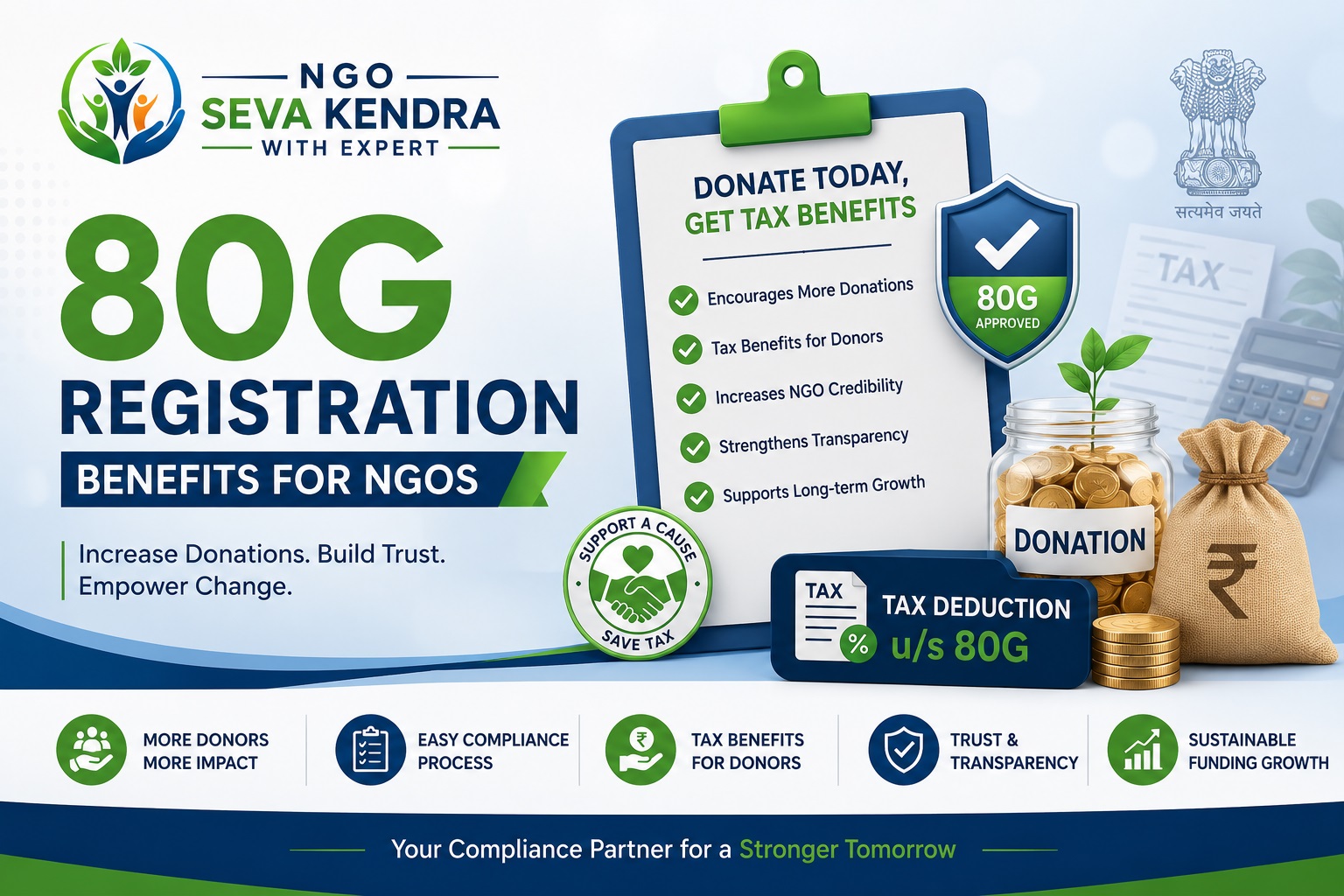
Understand how 80G registration can help NGOs attract donors, improve credibility and enable eligible donors to claim tax deductions on qualifying donations.
80G registration is an important tax-related approval for eligible charitable organisations in India. It can make an NGO more attractive to individual and corporate donors by providing a framework under which qualifying donations may be eligible for deduction under Section 80G of the Income Tax Act, subject to applicable conditions.
Quick Summary
If you are planning to obtain 80G registration for your NGO, here are the key points to know:
- 80G approval can help an eligible NGO encourage donations.
- Eligible donors may claim a deduction for qualifying donations under Section 80G.
- The deduction can be 100% or 50%, depending on the applicable category.
- Some categories are subject to a qualifying limit.
- Cash donations exceeding ₹2,000 are not eligible for deduction under Section 80G.
- The NGO must maintain proper donation records and comply with applicable reporting requirements.
- Form 10BD is used for furnishing the statement of donations received, and Form 10BE is relevant to donation certificates issued to donors.
- Donors should verify the NGO’s eligibility and use the details provided by the NGO when claiming the deduction.
- 80G approval can improve donor confidence and make the NGO more professionally prepared for fundraising.
Introduction
For an NGO, receiving regular donations is essential for sustaining charitable activities and expanding social-impact programmes. However, donors often want more than just an opportunity to support a good cause. They also look for transparency, legal compliance and a clear mechanism for documenting their contributions.
This is where 80G registration becomes important.
Section 80G of the Income Tax Act provides deductions for eligible donations made to specified funds and charitable institutions, subject to the conditions and limits applicable to the relevant category. Depending on the category, the deduction may be 100% or 50%, and some categories are subject to a qualifying limit.
For an eligible NGO, obtaining and maintaining 80G approval can therefore support fundraising efforts while strengthening donor confidence.
What is 80G Registration?
80G registration refers to the approval under Section 80G of the Income Tax Act that enables eligible charitable institutions and organisations to receive donations that may qualify for deduction in the hands of eligible donors, subject to applicable conditions.
The important point is that 80G does not mean that every donation automatically receives a 100% tax deduction.
The Income Tax Department recognises different categories of eligible donations. Depending on the applicable category, a donation may qualify for:
- 100% deduction without a qualifying limit
- 50% deduction without a qualifying limit
- 100% deduction subject to a qualifying limit
- 50% deduction subject to a qualifying limit
The applicable category should therefore be determined before communicating tax benefits to donors.
For NGOs, 80G approval is particularly useful because it can make the organisation more attractive to donors who are eligible to claim deductions.
Who Should Apply for 80G Registration?
80G registration may be relevant for charitable organisations that intend to raise funds from donors and want eligible donors to receive the applicable tax deduction for qualifying contributions.
It can be considered by organisations such as:
- Charitable Trusts
- Registered Societies
- Section 8 Companies
- Other eligible charitable institutions or organisations
An NGO should first ensure that its legal structure, charitable objectives, activities, records and other applicable requirements are in order before applying.
80G approval should not be treated as a substitute for basic NGO registration. The organisation should have an appropriate legal structure and comply with the requirements applicable to its activities.
Eligibility for 80G Registration
Eligibility depends on the organisation’s legal status, charitable objectives, activities, documentation and compliance with applicable provisions of the Income Tax Act.
General Eligibility Checklist
| Requirement | What the NGO Should Have |
|---|---|
| Legal Status | A valid legal structure such as Trust, Society or Section 8 Company |
| Charitable Objectives | Objects should support charitable or eligible purposes |
| Genuine Activities | Activities should be carried out in accordance with the organisation’s stated objectives |
| Proper Records | Financial and donation records should be maintained properly |
| PAN | Valid PAN of the organisation |
| Bank Account | Organisation’s bank account and supporting details |
| Income Tax Compliance | Applicable income tax filings and records |
| Books & Accounts | Proper financial records where applicable |
| Donation Records | Proper records of donations received |
| Reporting Compliance | Applicable reporting requirements should be followed |
Important: Eligibility is not determined solely by having an NGO registration certificate. The organisation must satisfy the applicable requirements under the Income Tax Act and related rules.
Documents Required for 80G Registration
The exact documents can vary depending on the organisation’s legal structure and circumstances.
Commonly required documents may include:
Organisation Documents
- Trust Deed / Society Registration Certificate / Certificate of Incorporation
- Memorandum of Association and Articles of Association, where applicable
- Registration certificate
- PAN of the organisation
- Details of trustees, governing body members or directors
- Address proof of the organisation
Financial Documents
- Bank account details
- Audited financial statements, where applicable
- Income & Expenditure Statement
- Balance Sheet
- Income Tax Return records, where applicable
- Details of donations received
Activity-Related Documents
- Details of charitable activities
- Activity reports
- Photographs or supporting evidence of activities, where relevant
- Details of projects undertaken
- Details of beneficiaries, where applicable
The exact documentation should be checked according to the NGO’s structure and current requirements before filing.
80G Registration Process
The 80G registration process generally involves preparing the organisation’s legal, financial and activity-related information and submitting the applicable application through the Income Tax Department’s prescribed process.
Step 1 — Review NGO Eligibility
First, review the NGO’s legal structure, charitable objects, activities and compliance status.
Step 2 — Collect Required Documents
Collect the organisation’s registration documents, PAN, governing documents, financial records, activity details and other applicable documents.
Step 3 — Review Income Tax Compliance
Check whether the organisation has completed its applicable income tax registrations, filings and related compliance requirements.
Step 4 — Prepare the Application
Prepare the applicable application and supporting information carefully.
Step 5 — Submit the Application
Submit the application and required documents through the prescribed Income Tax Department process.
Step 6 — Respond to Queries
The Income Tax Department may request additional information or clarification. The organisation should respond within the prescribed time.
Step 7 — Receive Approval
After successful processing, the applicable approval/order is issued.
Step 8 — Maintain Ongoing Compliance
After obtaining approval, the NGO must continue maintaining proper records and comply with applicable reporting and tax requirements.
Benefits of 80G Registration for NGOs
Obtaining 80G approval can provide several practical advantages for a charitable organisation.
1. Helps Attract More Donors
Donors may be more willing to contribute when they know that qualifying donations can provide an applicable tax deduction.
This can make 80G approval a useful fundraising advantage.
2. Improves Donor Confidence
A properly registered and compliant NGO can appear more transparent and professionally managed to prospective donors.
3. Supports Fundraising
80G approval can make fundraising communication stronger because eligible donors can be informed about the applicable tax deduction, subject to the relevant conditions.
4. Encourages Documented Donations
80G-related compliance requires proper handling of donation information and records, encouraging the organisation to maintain better documentation.
5. Strengthens Professional Credibility
An NGO with appropriate registrations and tax-related approvals can present itself more professionally when approaching donors, institutions and potential partners.
6. Helps Build Long-Term Donor Relationships
Providing appropriate donation documentation and maintaining proper records can help create a more structured donor-management process.
7. Useful for Individual and Institutional Donors
Depending on the donor’s circumstances and applicable tax provisions, 80G can make donations more attractive to eligible taxpayers.
How 80G Benefits Donors
The primary tax benefit of 80G is generally available to the donor, not the NGO.
If a qualifying donation is made to an eligible institution, the donor may be able to claim the applicable deduction while filing their income tax return, subject to the conditions of Section 80G.
The deduction category can vary. The Income Tax Department currently recognises categories involving 100% or 50% deduction, with some categories subject to a qualifying limit.
Example
Suppose a donor contributes ₹50,000 to an eligible organisation.
The amount of deduction cannot simply be assumed to be ₹50,000.
The donor must determine:
- Whether the organisation is eligible.
- Whether the donation qualifies.
- Which 80G category applies.
- Whether a qualifying limit applies.
- Whether the donor is eligible to claim the deduction.
- Whether the applicable tax regime permits the deduction.
For AY 2026–27, the Income Tax Department’s validation rules state that Section 80G deduction cannot be claimed when the new tax regime is selected.
Therefore, NGOs should avoid advertising 80G as an unconditional “tax saving” on every donation.
How Much Tax Deduction Can Donors Claim?
The amount of deduction depends on the category of donation.
| Donation Category | Possible Deduction |
| Specified eligible donations | 100% |
| Certain other eligible donations | 50% |
| Donations subject to qualifying limit | 100% or 50%, depending on category |
| Cash donation above ₹2,000 | Not eligible for deduction under Section 80G |
The Income Tax Department confirms that Section 80G donations can fall into 100% or 50% deduction categories, with or without a qualifying limit.
For donations subject to a qualifying limit, the Income Tax Department’s current guidance explains that the qualifying limit is generally calculated with reference to 10% of Adjusted Total Income.
Important
Do not state on your NGO website that:
“All donations get 100% tax deduction.”
That statement is incorrect.
The applicable deduction depends on the specific category and conditions.
Government Fees for 80G Registration
The government fee structure and professional charges are separate matters.
The NGO should distinguish between:
Government / Statutory Charges
Any applicable statutory or government charges associated with the prescribed process.
Professional Fees
Fees charged by a consultant or professional for:
- Documentation
- Application preparation
- Filing
- Compliance review
- Responding to queries
- Follow-up and professional assistance
Because statutory requirements and professional charges can change, NGOs should confirm the applicable amount before starting the application.
80G Registration Timeline
The timeline can vary depending on:
- Completeness of documents
- Organisation’s legal structure
- Financial records
- Previous tax registrations
- Queries raised by the Income Tax Department
- Accuracy of the application
- Response time to departmental queries
A well-prepared application with complete documentation generally has a smoother processing experience.
Recommended website wording:
“The timeline for 80G registration depends on the completeness of documents and processing by the Income Tax Department. NGO Seva Kendra provides end-to-end assistance with documentation, application filing and responses to queries.”
Avoid promising a guaranteed approval date.
Important Compliance After 80G Approval
Obtaining 80G approval is not the end of the process.
An NGO should continue maintaining appropriate records and fulfilling applicable compliance requirements.
Donation Records
Maintain accurate details of donations received.
Financial Records
Maintain proper books of accounts and supporting financial documents.
Donation Reporting
Eligible organisations are required to follow applicable donation reporting requirements.
Form 10BD is used for furnishing the statement of donations received, and the Income Tax Department identifies the due date as 31 May of the financial year immediately following the financial year in which the donation is received.
Donation Certificates
The applicable donation certificate/document should be provided to donors as required.
Income Tax Compliance
Continue filing applicable income tax returns and other prescribed forms.
Maintain Accurate Donor Information
PAN and other required donor information should be collected and maintained accurately wherever required.
Common Mistakes to Avoid
1. Treating 80G as a One-Time Compliance
Obtaining approval does not mean that the NGO can stop maintaining records.
2. Promising 100% Tax Deduction
Not every donation qualifies for a 100% deduction.
3. Ignoring the ₹2,000 Cash Rule
Cash donations exceeding ₹2,000 are not eligible for deduction under Section 80G.
4. Incorrect Donor Information
Incorrect donor details can create problems during donation reporting and certificate generation.
5. Poor Financial Documentation
Incomplete or inconsistent financial records can make compliance more difficult.
6. Missing Reporting Deadlines
Applicable statements and forms should be filed within the prescribed timelines.
7. Using Outdated Information
Tax rules and compliance requirements can change. NGOs should use the latest applicable requirements rather than relying on old articles or templates.
Frequently Asked Questions
What is 80G registration for an NGO?
80G approval allows qualifying donations made to eligible organisations to potentially qualify for a tax deduction in the hands of eligible donors, subject to applicable conditions.
Is 80G the same as 12A registration?
No. 12A/12AB-related registration and 80G serve different purposes. 12A/12AB primarily concerns the tax treatment of an eligible charitable organisation’s income, while 80G relates to deductions available to eligible donors for qualifying donations.
Does every donation receive a 100% deduction under 80G?
No. The applicable deduction can be 100% or 50%, and some categories are subject to a qualifying limit.
Can cash donations qualify for 80G deduction?
Cash donations exceeding ₹2,000 do not qualify for deduction under Section 80G.
Can an NGO with 80G approval receive donations from companies?
Yes, an NGO may receive donations from companies, subject to the applicable legal, tax and corporate compliance requirements. 80G approval does not itself guarantee corporate or CSR funding.
Is 80G useful for fundraising?
Yes. It can make the organisation more attractive to eligible donors because qualifying donations may provide a tax deduction, subject to applicable conditions.
Is 80G registration mandatory for every NGO?
No. Not every NGO is required to obtain 80G approval. However, organisations that depend on donations may consider it an important tax-related approval where eligible.
Can donors claim 80G deduction under the new tax regime?
For AY 2026–27, the Income Tax Department’s ITR validation rules state that Section 80G deductions cannot be claimed when the new tax regime is selected.
What is Form 10BD?
Form 10BD is the statement of donations received that eligible charitable organisations are required to furnish as applicable. The Income Tax Department currently specifies 31 May of the following financial year as the due date for the statement.
What happens if an NGO does not maintain proper donation records?
Incorrect or incomplete donation records can create compliance issues and may affect the accuracy of donation reporting and certificates.
How long does 80G registration take?
The processing time can vary depending on documentation, departmental processing and whether additional information or clarification is requested.
Related NGO Services
If your organisation is planning to obtain 80G approval, you may also need other registrations and compliance services.
12A / 12AB Registration
Helps eligible charitable organisations with the applicable income-tax exemption framework.
NGO Darpan Registration
Helps eligible NGOs obtain registration on the NITI Aayog NGO Darpan portal.
PAN & TAN Registration
Required for various tax and compliance activities of organisations.
CSR-1 Registration
Relevant for eligible entities intending to undertake CSR activities as implementing agencies, subject to applicable requirements.
NGO Annual Compliance
Helps organisations maintain their ongoing statutory, financial and tax compliance.
Digital Signature Certificate
Useful for various online government and tax-related filings where a DSC is required.
Final Thoughts
80G approval can be an important part of an NGO’s fundraising and compliance framework.
Its biggest practical advantage is not simply the registration itself, but the ability to provide eligible donors with a properly documented donation process where qualifying contributions may receive the applicable deduction under Section 80G.
However, NGOs should remember that the tax benefit is subject to specific conditions, deduction categories and the donor’s own tax circumstances. Current Income Tax Department guidance recognises different deduction categories and also restricts deductions for cash donations above ₹2,000.
A properly documented, transparent and compliant NGO is better positioned to build long-term donor relationships and strengthen its fundraising capabilities.
Important Disclaimer
This article is intended for general informational purposes and should not be treated as legal, tax or financial advice. Tax deductions under Section 80G depend on the applicable provisions, the category of donation, the eligibility of the doner organisation and the donor’s individual circumstances. Tax laws and compliance requirements may change. NGOs and donors should verify the latest applicable provisions with the Income Tax Department or a qualified tax professional.