Quick Summary
Running an NGO involves more than carrying out charitable activities. NGOs must maintain proper financial records, complete applicable tax filings, maintain statutory registrations and submit annual compliance forms within the prescribed timelines.
The exact requirements depend on whether the NGO is registered as a Trust, Society or Section 8 Company, and whether it has registrations or approvals such as 12A/12AB, 80G, CSR-1 or FCRA.
This NGO Annual Compliance Checklist covers the major compliances NGOs should review every financial year, including accounting, audit, income tax return filing, donation reporting, FCRA compliance and company-related filings.
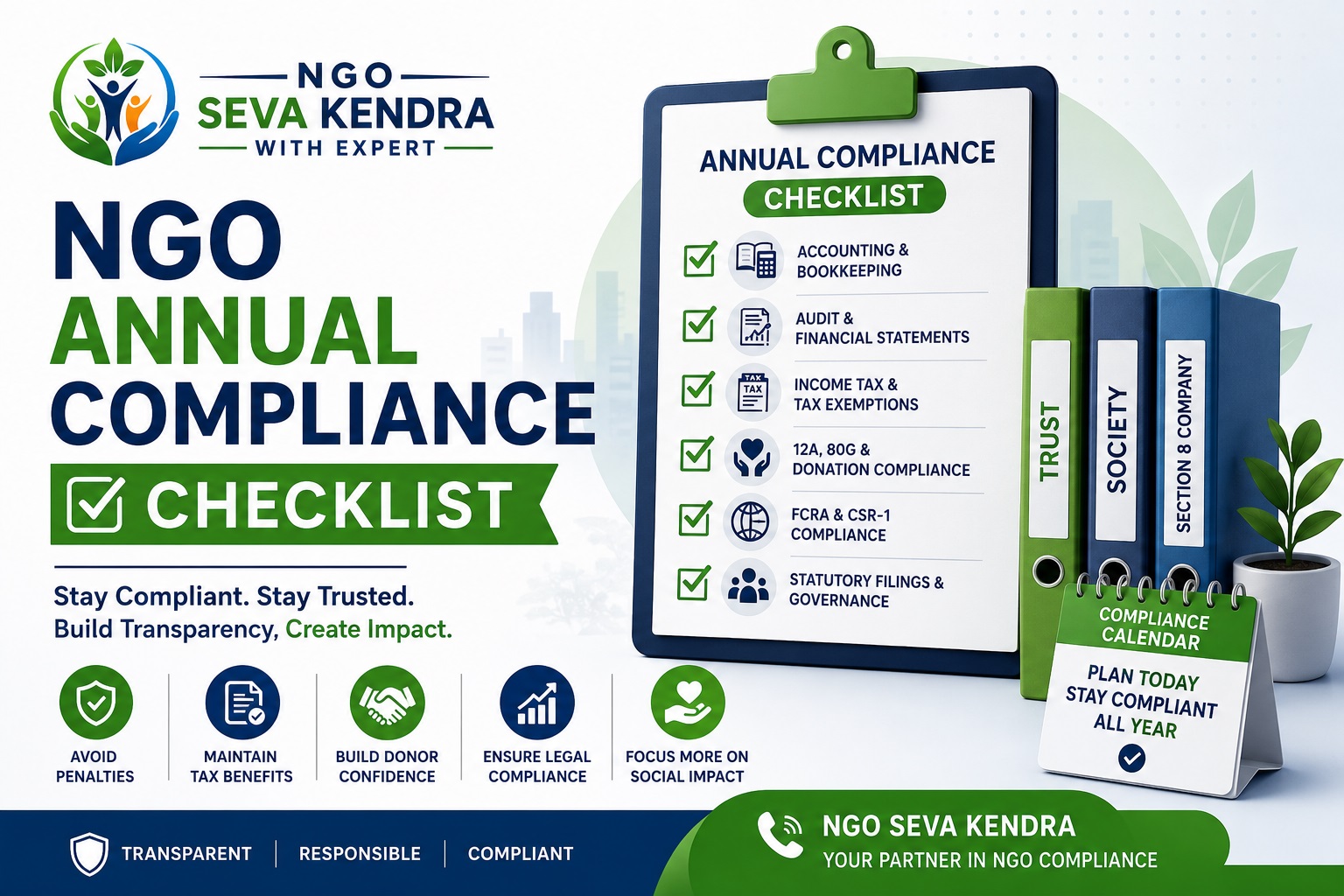
Key Compliance Areas
- Accounting and bookkeeping
- Annual financial statements
- Audit and audit reports
- Income Tax Return filing
- 12A/12AB compliance
- 80G compliance
- Form 10BD and Form 10BE
- FCRA annual return, where applicable
- Section 8 Company annual filings
- CSR-1 related requirements
- TDS and GST compliance, where applicable
- Maintenance of statutory records
- Board/Trustee/General Body meetings
- Annual reports and documentation
Introduction
An NGO may be established to work for education, healthcare, poverty relief, social welfare, environmental protection, women empowerment, child welfare or other charitable purposes.
However, registration is only the beginning.
After registration, an NGO must continue to maintain proper books of accounts, comply with applicable tax laws, submit annual returns and maintain records relating to its activities and finances.
The annual compliance requirements are not identical for every NGO. A Trust, Society and Section 8 Company have different statutory requirements, while additional compliances may apply if the NGO has 12A/12AB registration, 80G approval, FCRA registration, CSR-1 registration or GST/TDS obligations.
Therefore, NGOs should review their compliance requirements every financial year and complete applicable filings within the prescribed timelines.
What is NGO Annual Compliance?
NGO annual compliance refers to the various legal, financial, accounting and tax-related requirements that an NGO must complete during or after the end of each financial year.
These compliances help ensure that:
- The NGO maintains accurate financial records.
- Donations and grants are properly recorded.
- Funds are used for permitted charitable activities.
- Tax exemptions are maintained where applicable.
- Government registrations remain compliant.
- Donor information is properly reported.
- Statutory records are maintained.
- The organisation remains legally and financially transparent.
The exact compliance requirements depend on the NGO’s legal structure and the registrations or approvals it holds.
Why is Annual Compliance Important for NGOs?
Annual compliance is important because an NGO’s credibility depends not only on its social work but also on proper legal and financial management.
1. Maintains Legal Status
Regular compliance helps an NGO remain in good standing with the relevant authorities.
2. Protects Tax Benefits
NGOs registered under applicable provisions of the Income Tax Act need to meet the prescribed conditions to claim tax benefits and exemptions.
3. Builds Donor Confidence
Proper accounts, donation records and annual filings demonstrate financial transparency and responsible management.
4. Supports CSR Funding
Companies looking to support NGOs through CSR programmes often review the organisation’s registration, compliance and financial records before entering into a partnership.
5. Helps Avoid Penalties
Delayed or incorrect filings can result in additional fees, penalties, notices or other compliance issues.
6. Makes Future Registrations Easier
Maintaining proper records makes future applications, renewals, amendments and government registrations considerably easier.
NGO Annual Compliance Checklist
The following checklist provides a practical overview of the major compliance areas that an NGO should review every financial year.
| Compliance Area | What to Check | Applicable To |
|---|---|---|
| Books of Accounts | Maintain proper financial records | All NGOs |
| Annual Accounts | Prepare income & expenditure statement, balance sheet etc. | All NGOs |
| Audit | Complete applicable statutory/tax audit | As applicable |
| Income Tax Return | File applicable return | Applicable NGOs |
| Form 10B/10BB | Obtain and file applicable audit report | Eligible entities |
| Form 10BD | Report eligible donations | NGOs covered by 80G reporting requirements |
| Form 10BE | Issue donation certificates | Applicable 80G entities |
| FCRA FC-4 | File annual return | FCRA registered NGOs |
| TDS | Deduct, deposit and report TDS where applicable | Applicable NGOs |
| GST | Complete applicable GST compliance | Registered NGOs |
| MCA Filings | File applicable company forms | Section 8 Companies |
| Meetings | Hold required meetings and maintain minutes | Depending on legal structure |
| Statutory Registers | Update required records | Depending on legal structure |
Important: This table is a general checklist. An NGO should determine its exact obligations based on its legal structure, registrations, activities, receipts and applicable laws.
Common Compliance for All NGOs
Although the exact legal requirements differ, most NGOs should maintain the following basic records.
1. Maintain Proper Books of Accounts
The NGO should maintain accurate records of:
- Donations received
- Grants received
- Programme expenses
- Administrative expenses
- Employee payments
- Bank transactions
- Fixed assets
- Loans and liabilities
- Investments, where applicable
- Foreign contributions, where applicable
All transactions should be properly supported by invoices, receipts, vouchers, bank statements and other relevant documents.
2. Prepare Annual Financial Statements
At the end of the financial year, the NGO should prepare appropriate financial statements and supporting schedules.
These may include:
- Balance Sheet
- Income and Expenditure Account
- Receipts and Payments Account
- Schedules and notes
- Fixed asset records
- Donation records
- Grant utilisation records
The exact format and requirements may differ depending on the legal structure.
3. Complete Applicable Audit
Depending on the NGO’s structure and tax position, an audit may be required under the applicable law.
For charitable or religious trusts/institutions covered under the relevant provisions, the Income Tax Department provides for Form 10B or Form 10BB, depending on the applicable conditions.
Trust Annual Compliance
A charitable trust should review its applicable requirements every financial year.
Common areas include:
- Maintaining books of accounts
- Preparing annual financial statements
- Completing applicable audit
- Filing applicable income tax return
- Maintaining 12A/12AB compliance
- Maintaining 80G compliance, where applicable
- Filing Form 10BD, where applicable
- Issuing Form 10BE, where applicable
- Filing Form 10/9A, where applicable
- Maintaining trustee and meeting records
- Maintaining donation and grant records
The exact requirements can depend on the trust’s activities, income, registrations and tax position.
Society Annual Compliance
A registered society may have compliance requirements under the applicable state-specific Societies Registration law.
Depending on the state and governing law, a society may need to maintain:
- Books of accounts
- Annual financial statements
- Audit reports, where applicable
- Annual/periodic returns
- Governing body records
- General body meeting records
- Minutes of meetings
- Membership records
- Changes in office bearers, where applicable
- Income Tax compliance
- 12A/12AB and 80G related compliance, where applicable
Important: Society compliance can vary significantly from one state to another. Therefore, the applicable state law should always be checked before filing.
Section 8 Company Annual Compliance
A Section 8 Company is incorporated under the Companies Act, 2013 and has company-law compliance requirements in addition to applicable tax compliances.
Common areas include:
1. Annual General Meeting
The company should conduct its Annual General Meeting as required under the Companies Act.
2. Financial Statements
The company should prepare its annual financial statements and complete the applicable audit.
3. Filing of Financial Statements
The applicable financial statement filing should be completed with the Ministry of Corporate Affairs.
4. Annual Return
The applicable annual return should be filed with the MCA.
5. Board Meetings and Minutes
Required Board and other statutory meetings should be conducted and properly documented.
6. Statutory Registers and Records
The company should maintain and update the statutory registers and records required under the Companies Act.
Because Section 8 Companies are companies under the Companies Act, their annual compliance should be handled separately from the compliance of a Trust or Society.
Income Tax Compliance for NGOs
Income Tax compliance is one of the most important areas for NGOs.
Depending on the organisation’s legal structure and tax position, the NGO may need to:
- Maintain books of accounts
- Complete applicable audit
- File the appropriate income tax return
- Maintain 12A/12AB registration
- Maintain 80G approval, where applicable
- Report donations through Form 10BD, where applicable
- Issue Form 10BE to eligible donors
- File Form 10/9A, where applicable
- Maintain supporting documents for income and expenditure
The Income Tax Department currently lists ITR-7 for persons, including certain companies, required to file returns under sections including 139(4A), 139(4B), 139(4C) and 139(4D). Charitable/religious trusts covered under section 139(4A) fall within this framework.
12A/12AB Compliance
NGOs claiming exemption under Sections 11 and 12 should pay particular attention to maintaining their 12A/12AB compliance.
This includes:
- Maintaining proper books
- Using income for permitted charitable purposes
- Maintaining supporting documentation
- Completing applicable audit requirements
- Filing the appropriate income tax return
- Filing Form 10 or Form 9A where applicable
- Reporting relevant changes in objects or activities where required
The Income Tax Department states that Form 10B is an audit report for certain charitable or religious trusts/institutions registered under Section 12A or which have applied through Form 10A, subject to the applicable conditions.
80G Compliance
An NGO holding 80G approval should maintain proper donation records and comply with the applicable reporting requirements.
Important areas include:
- Maintaining donor details
- Recording donation amounts accurately
- Maintaining donation receipts
- Maintaining payment-mode records
- Filing Form 10BD where applicable
- Issuing Form 10BE to eligible donors
Form 10BD and Form 10BE Compliance
Form 10BD is a statement of donations received by specified institutions covered by the applicable 80G provisions.
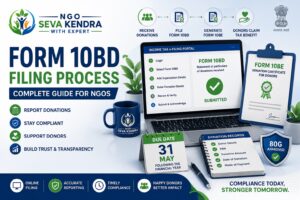
The Income Tax Department states that Form 10BD is to be furnished electronically and that the due date is 31 May immediately following the financial year in which the donation was received. After filing Form 10BD, Form 10BE is issued to donors.
Form 10BD
Form 10BD contains prescribed information relating to donations received.
Form 10BE
Form 10BE is the donation certificate provided to eligible donors.
Important Due Date
31 May following the end of the relevant financial year.
Important Point
If no donation is received during the relevant financial year, the Income Tax Department’s FAQ states that Form 10BD is not required for that year.
FCRA Annual Compliance
NGOs registered under the Foreign Contribution (Regulation) Act, 2010 have additional compliance requirements.
One of the important annual requirements is filing Form FC-4.
According to the FCRA FAQ, the annual return is filed online for every financial year and is generally required within nine months from the close of the financial year, i.e. by 31 December. The FAQ also states that a NIL return is mandatory even where there was no receipt or utilisation of foreign contribution during the year.
FCRA Compliance Checklist
- Maintain separate FCRA accounting records
- Maintain records of foreign contributions
- Record utilisation of foreign contribution
- Maintain FCRA bank account records
- Prepare required financial statements
- Obtain CA certification where required
- File Form FC-4
- File NIL return where applicable
- Maintain supporting documents
TDS and GST Compliance
Some NGOs may also have tax compliance obligations depending on their activities and transactions.
TDS Compliance
Where TDS provisions apply, the NGO may need to:
- Deduct TDS
- Deposit TDS within the prescribed timeline
- File TDS returns
- Issue applicable TDS certificates
- Maintain TDS records
GST Compliance
GST applicability depends on the NGO’s activities, supplies, registration status and applicable GST provisions.
An NGO should therefore determine whether its activities fall within GST requirements rather than assuming that charitable status automatically eliminates all GST obligations.
Important Documents NGOs Should Maintain
A professional NGO should maintain a central compliance file containing important documents.
Registration Documents
- Trust Deed / Society Registration Certificate / Certificate of Incorporation
- PAN
- TAN, where applicable
- 12A/12AB registration documents
- 80G approval
- CSR-1 registration
- FCRA registration, if applicable
- GST registration, if applicable
Financial Documents
- Bank statements
- Cash book
- Ledger
- Income and Expenditure Account
- Balance Sheet
- Receipts and Payments Account
- Donation receipts
- Grant documents
- Bills and vouchers
- Asset records
Compliance Documents
- Income Tax Return acknowledgement
- Audit report
- Form 10B/10BB, where applicable
- Form 10BD
- Form 10BE
- Form FC-4, where applicable
- MCA filing acknowledgements for Section 8 Companies
- TDS returns
- GST returns, where applicable
NGO Annual Compliance Timeline
The following is a general planning calendar, not a universal due-date chart. Exact dates can depend on the NGO’s structure, financial position and applicable law.
| Period | Compliance Activity |
|---|---|
| April–June | Close previous financial year accounts and organise records |
| May | Form 10BD / Form 10BE deadline for applicable entities |
| April–September | Audit, accounting and statutory records preparation |
| September–October | Income Tax and audit-related compliance planning |
| Throughout the Year | TDS/GST and other periodic compliance |
| December | FCRA FC-4 annual return deadline, where applicable |
| Throughout the Year | Section 8 Company Board/AGM and MCA compliance as applicable |
For example, Form 10BD/10BE has a 31 May deadline, while FCRA FC-4 is generally due by 31 December.
Common NGO Compliance Mistakes
1. Treating Registration as the End of Compliance
Obtaining NGO registration does not mean that annual compliance is complete.
2. Maintaining Poor Financial Records
Missing invoices, receipts or bank records can create difficulties during audits and filings.
3. Missing Donation Reporting
NGOs with applicable 80G reporting obligations should maintain accurate donor information and complete Form 10BD/10BE requirements within the prescribed timeline.
4. Ignoring FCRA Compliance
FCRA-registered NGOs must separately track foreign contribution and comply with FCRA reporting requirements.
5. Filing the Wrong Audit Form
The applicable audit form can depend on the NGO’s circumstances. The Income Tax Department has specifically highlighted the distinction between Form 10B and Form 10BB.
6. Not Maintaining Minutes and Statutory Records
Legal and governance records should be maintained throughout the year rather than recreated at the time of filing.
7. Depending Completely on the Previous Year’s Compliance
An NGO’s obligations can change when its income, donations, activities, registrations or funding sources change.
Consequences of NGO Non-Compliance
Failure to complete applicable compliance requirements can create several problems.
These may include:
- Late fees
- Penalties
- Notices from authorities
- Difficulty maintaining tax benefits
- Problems with donor reporting
- FCRA compliance issues
- Difficulty receiving grants or CSR support
- Additional professional costs for corrective filings
- Reputational damage
For example, the Income Tax Department states that delayed filing of Form 10BD can attract a fee of ₹200 per day of delay, along with potential penalty under Section 271K subject to the applicable provisions.
Therefore, NGOs should treat annual compliance as an ongoing management responsibility rather than a last-minute filing exercise.
Frequently Asked Questions
1. Is annual compliance mandatory for every NGO?
The exact requirements depend on the NGO’s legal structure, registrations, activities and applicable laws. Trusts, Societies and Section 8 Companies do not have identical compliance requirements.
2. What are the main annual compliances of an NGO?
Common areas include accounting, financial statements, applicable audit, income tax return filing, 12A/12AB compliance, 80G compliance and donation reporting. FCRA, MCA, TDS and GST requirements may also apply depending on the NGO.
3. Do NGOs need to file an Income Tax Return?
Where the applicable provisions require a return, the NGO must file the prescribed income tax return. Certain charitable or religious entities are required to file ITR-7.
4. Is Form 10B mandatory for every NGO?
No. The applicable audit form depends on the organisation’s circumstances and the relevant provisions. Form 10B and Form 10BB have different applicability conditions.
5. What is the due date for Form 10BD?
The Income Tax Department states that Form 10BD is due on 31 May immediately following the financial year in which the donation was received.
6. Is Form 10BE also required?
Where Form 10BD reporting applies, eligible donors are provided Form 10BE after the donation statement is filed.
7. Does an NGO with FCRA registration have additional compliance?
Yes. FCRA-registered organisations have additional reporting and record-maintenance requirements, including the annual Form FC-4 return.
8. Is FCRA FC-4 required if there was no foreign donation?
The FCRA FAQ states that a NIL annual return is mandatory even when there is no receipt or utilisation of foreign contribution during the year.
9. Do Section 8 Companies have MCA compliance?
Yes. Section 8 Companies are companies incorporated under the Companies Act, 2013 and therefore have applicable corporate filings, financial statements, annual returns and governance requirements.
10. Can NGO annual compliance be handled by a professional?
Yes. NGOs commonly engage Chartered Accountants, Company Secretaries and other professionals for applicable accounting, audit, tax and statutory compliance.
Related NGO Services
For the NGO Seva Kendra website, I recommend linking this article to the following service pages:
NGO Registration Services
- Section 8 Company Registration
- Trust Registration
- Society Registration
NGO Tax & Compliance Services
- 12A/12AB Registration
- 80G Registration
- NGO Annual Compliance
- Form 10A Filing
- Form 10BD/10BE Compliance
Other NGO Services
- CSR-1 Registration
- NGO Darpan Registration
- PAN & TAN Registration
- Digital Signature Certificate
- FCRA Registration
This is also an excellent opportunity for internal linking because this article naturally connects to several of your existing service pages.
Final Thoughts
NGO annual compliance is an essential part of running a legally compliant and financially transparent organisation.
A well-managed NGO should not wait until the end of the financial year to start preparing its compliance documents. Financial records, donation information, statutory registers, meeting records and supporting documents should be maintained throughout the year.
Whether the organisation is registered as a Trust, Society or Section 8 Company, its compliance requirements should be reviewed based on its specific legal structure and registrations.
Regular compliance not only helps avoid penalties and notices but also strengthens the NGO’s credibility with donors, CSR partners, government authorities and other stakeholders.
Disclaimer: This article is intended for general informational purposes only and should not be considered legal, tax or professional advice. NGO compliance requirements may vary depending on the organisation’s legal structure, registrations, activities and applicable laws. Please consult a qualified professional for advice specific to your organisation.