Corporate Social Responsibility (CSR) has become an important source of funding for NGOs working in areas such as education, healthcare, rural development, women empowerment, environmental protection and social welfare.
However, receiving CSR funding is not simply about approaching a company and asking for financial support. NGOs need to meet certain legal and compliance requirements, identify suitable CSR opportunities, prepare strong project proposals and demonstrate transparency in the utilisation of funds.
This guide explains how NGOs receive CSR funding in India, what registrations are generally required, how the CSR funding process works, what companies look for in an NGO and how an NGO can improve its chances of securing CSR partnerships.
Quick Summary
- CSR funding is provided by eligible companies for approved CSR activities.
- NGOs can act as CSR implementing agencies if they satisfy the applicable legal requirements.
- Eligible implementing agencies generally need to complete CSR-1 registration with the Ministry of Corporate Affairs.
- Depending on the type of organisation and applicable rules, registrations such as 12A and 80G are important for NGO compliance and donor-related tax benefits.
- NGOs need a clear CSR project proposal before approaching companies.
- Companies generally evaluate an NGO’s legal status, track record, governance, financial transparency and project impact.
- CSR funding may support areas such as education, healthcare, rural development, environmental sustainability and livelihood development.
- NGOs should maintain proper accounts, utilisation records, project reports and supporting documents.
- Successful CSR partnerships are built around transparency, measurable impact and proper compliance.
What Is CSR Funding?
CSR funding refers to money spent by eligible companies on activities that fall within the Corporate Social Responsibility framework under Section 135 of the Companies Act, 2013 and the applicable CSR Rules.
Companies may undertake CSR activities themselves, collaborate with other companies or implement eligible CSR activities through qualifying implementing agencies. The Ministry of Corporate Affairs specifically recognises eligible Section 8 companies, registered public trusts, registered societies and certain other entities as possible implementing agencies, subject to the applicable conditions.
For NGOs, CSR funding can provide financial support for structured projects that create measurable social or environmental impact.
Unlike ordinary donations, CSR projects are generally expected to be connected to approved CSR activities and managed through appropriate planning, monitoring and reporting.
Why Do Companies Provide CSR Funding?
CSR is not simply charitable giving. Eligible companies have responsibilities under the CSR provisions of the Companies Act, and CSR expenditure is directed toward activities covered under Schedule VII.
Companies may support projects in areas such as:
- Education and vocational skills
- Healthcare and sanitation
- Rural development
- Women empowerment
- Livelihood development
- Environmental sustainability
- Poverty and hunger alleviation
- Safe drinking water
- Senior citizen welfare
- Support for disadvantaged communities
- Disaster management and relief
- Sports development
- Other activities covered under Schedule VII
The exact eligibility of a particular project should always be evaluated against the applicable CSR provisions and the company’s CSR policy.
How NGOs Can Receive CSR Funding
An NGO generally needs to approach CSR funding as a professional project partnership, rather than simply requesting a donation.
The broad process can be understood as:
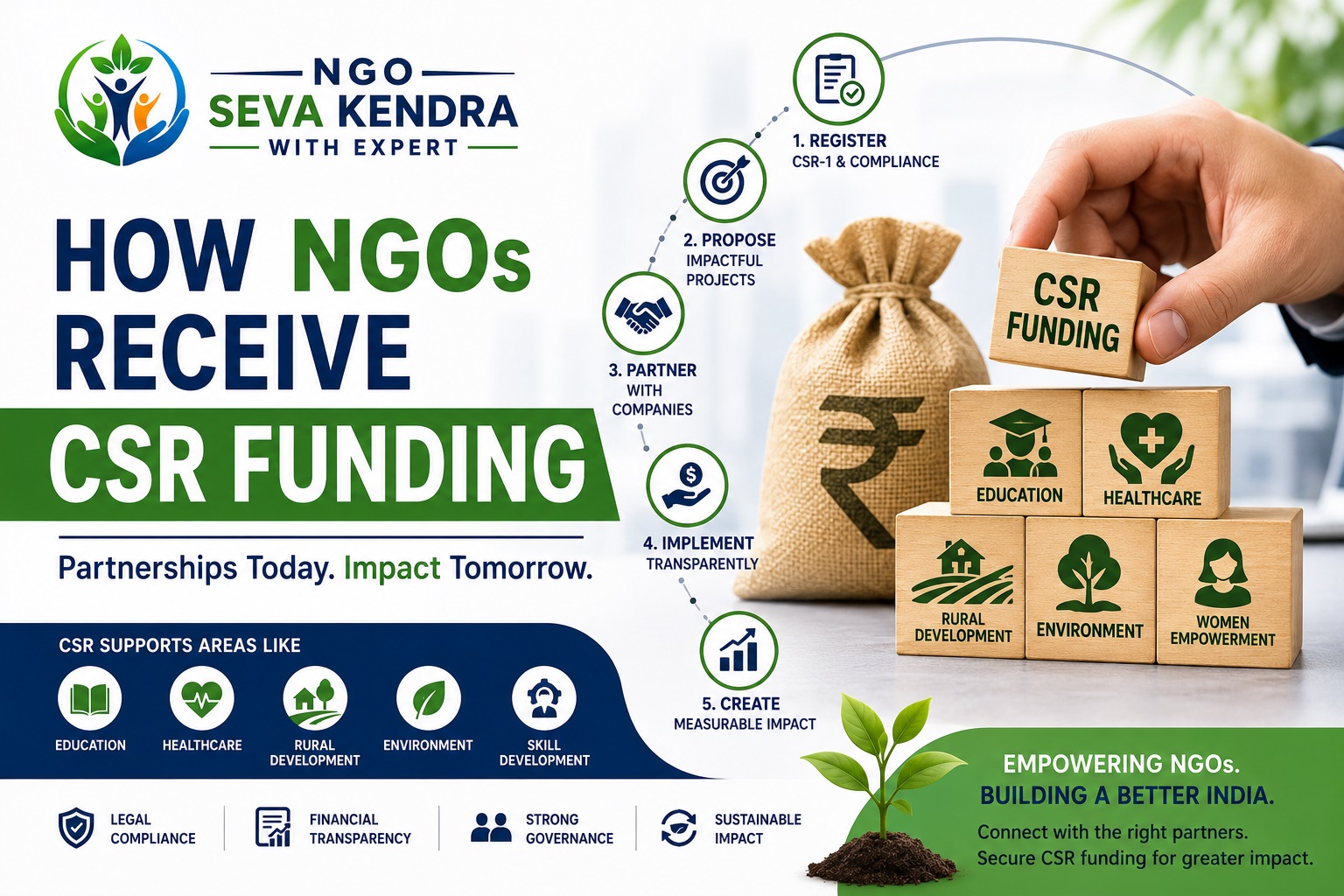
Legal Compliance → CSR Eligibility → Project Planning → Proposal Preparation → Company Identification → Proposal Submission → Due Diligence → Approval → Agreement → Project Implementation → Reporting
The NGO needs to demonstrate that it is legally compliant, capable of implementing the proposed project and able to provide transparent reporting on the utilisation of CSR funds.
Who Can Receive CSR Funding?
Not every NGO automatically qualifies to act as a CSR implementing agency.
Under the CSR Rules, eligible implementing agencies can include certain Section 8 companies, registered public trusts and registered societies meeting the applicable conditions, as well as certain government-established entities and statutory bodies. For specified independent implementing agencies, the rules also provide for an established track record of at least three years in undertaking similar activities.
Therefore, an NGO should first determine:
- Its legal structure
- Applicable tax registrations
- Whether it satisfies CSR implementing agency requirements
- Whether CSR-1 registration is applicable
- Whether it has the required track record, where applicable
- Whether its proposed activities fall within permissible CSR activities
Important Registrations for NGOs
Before approaching companies for CSR partnerships, an NGO should ensure that its legal and financial documentation is properly maintained.
Depending on the organisation and its circumstances, important registrations and documents may include:
| Registration / Document | Purpose |
|---|---|
| NGO Registration | Establishes the legal identity of the organisation |
| PAN | Required for financial and tax-related activities |
| 12A Registration | Provides applicable income-tax exemption benefits subject to conditions |
| 80G Approval | Allows eligible donors to claim applicable tax deductions subject to conditions |
| CSR-1 Registration | Registration for eligible CSR implementing agencies |
| NGO Darpan Registration | Government portal registration that may be useful for government-related NGO activities |
| FCRA Registration | Required where an NGO receives foreign contribution, subject to applicable law |
| Bank Account | Required for receiving and managing project funds |
| Audited Financial Statements | Demonstrates financial transparency |
| Annual Reports | Shows organisational activities and impact |
The exact requirements vary according to the NGO’s legal structure and activities.
What Is CSR-1 Registration?
CSR-1 is an electronic registration mechanism for entities that fall within the applicable categories of CSR implementing agencies.
Under the CSR Rules, entities covered by the relevant implementing-agency provisions must register with the Central Government by filing Form CSR-1 electronically with the Registrar. The form is electronically signed by the entity and digitally verified by a practising Chartered Accountant, Company Secretary or Cost Accountant. After submission, a unique CSR Registration Number is generated by the system.
CSR-1 is therefore an important compliance requirement for eligible NGOs seeking to undertake CSR activities as implementing agencies.
How CSR-1 Helps NGOs
CSR-1 registration helps establish an NGO’s status within the CSR implementation framework.
It can help an eligible NGO:
- Establish its CSR implementing agency registration
- Participate in CSR project opportunities
- Provide its CSR Registration Number to companies during due diligence
- Demonstrate that the organisation has completed the applicable CSR registration requirement
- Improve its compliance profile when approaching corporate partners
However, CSR-1 registration by itself does not guarantee CSR funding.
An NGO still needs to demonstrate strong governance, relevant experience, project capability, transparency and measurable impact.
Types of Projects Eligible for CSR Funding
CSR projects should relate to activities covered under Schedule VII of the Companies Act.
Depending on the applicable provisions, CSR projects may cover areas such as:
Education and Skill Development
Projects may include:
- School education
- Digital education
- Vocational training
- Skill development
- Scholarships and educational support
- Adult literacy
- Employment-oriented training
Healthcare and Sanitation
Projects may focus on:
- Medical camps
- Healthcare awareness
- Preventive healthcare
- Sanitation
- Safe drinking water
- Public health initiatives
Rural Development
Examples include:
- Rural infrastructure
- Livelihood development
- Community development
- Skill training
- Access to basic facilities
Women Empowerment
Projects may include:
- Skill development
- Livelihood programmes
- Entrepreneurship support
- Education
- Health and awareness initiatives
Environmental Sustainability
CSR projects may focus on:
- Environmental conservation
- Afforestation
- Water conservation
- Waste management
- Renewable energy
- Biodiversity protection
The project should be carefully mapped against the applicable CSR provisions before submitting a proposal.
Documents NGOs Should Keep Ready
A company may conduct due diligence before selecting an NGO as an implementing partner.
An NGO should therefore maintain an organised documentation folder containing:
- Certificate of Registration / Incorporation
- PAN Card
- 12A Registration / applicable tax registration
- 80G approval, where applicable
- CSR-1 registration details
- NGO Darpan details, where applicable
- FCRA documents, if applicable
- Memorandum of Association / Trust Deed / Society documents
- Governing body details
- Bank account details
- Audited financial statements
- Income-tax returns
- Annual reports
- Previous project reports
- Photographs and project evidence
- Beneficiary data
- Organisation profile
- Key personnel details
- Project proposal
- Budget and cost estimates
- Monitoring and evaluation plan
Keeping these documents ready can make the corporate due-diligence process smoother.
How to Prepare a CSR Project Proposal
A professional CSR proposal is one of the most important documents when approaching a company.
Your proposal should clearly answer:
What is the problem?
Explain the social or environmental problem that the project intends to address.
Who will benefit?
Clearly define the target beneficiaries.
For example:
- 500 school students
- 200 women
- 1,000 rural households
- 300 senior citizens
Where will the project be implemented?
Mention the state, district, city, village or specific geographical area.
What will the NGO do?
Clearly explain the activities that will be undertaken.
How much will the project cost?
Provide a transparent and realistic budget.
What will be the expected impact?
Define measurable outcomes.
How will the project be monitored?
Explain how progress will be tracked and reported.
What a Strong CSR Proposal Should Include
A professional CSR proposal can contain:
- Executive Summary
- About the NGO
- Legal and Compliance Details
- Problem Statement
- Project Objectives
- Target Beneficiaries
- Geographic Coverage
- Proposed Activities
- Implementation Methodology
- Project Timeline
- Expected Outcomes
- Monitoring & Evaluation
- Project Budget
- Organisation’s Previous Experience
- Sustainability Plan
- Reporting Mechanism
- Contact Details
A proposal should be specific, measurable and company-focused, rather than simply describing the NGO’s general activities.
Step-by-Step Process to Receive CSR Funding
Step 1: Complete NGO Compliance
Ensure that the organisation has the applicable legal registrations and financial documentation.
Step 2: Determine CSR Eligibility
Check whether the NGO qualifies to undertake CSR activities under the applicable CSR Rules.
Step 3: Complete CSR-1 Registration
Where applicable, complete CSR-1 registration and obtain the CSR Registration Number.
Step 4: Identify a Suitable CSR Project
Select a project that addresses a genuine social need and falls within the permissible CSR framework.
Step 5: Prepare the Project Proposal
Create a professional proposal containing objectives, beneficiaries, activities, timeline, budget and expected outcomes.
Step 6: Identify Potential Companies
Research companies whose CSR priorities match your project.
Look for companies with CSR interests in:
- Education
- Healthcare
- Rural development
- Women empowerment
- Environment
- Skill development
- Livelihood
Step 7: Approach the CSR Team
Approach the company’s:
- CSR Department
- Corporate Foundation
- Sustainability Team
- Corporate Affairs Team
- CSR Head
Send a concise introduction along with the project proposal and organisation profile.
Step 8: Corporate Due Diligence
The company may review:
- Legal documents
- Financial records
- NGO registrations
- Previous projects
- Track record
- Governance
- Project proposal
- Beneficiary information
- CSR compliance
Step 9: Project Evaluation
The company may evaluate the project’s feasibility, impact, budget and alignment with its CSR priorities.
Step 10: Approval and Agreement
If the company approves the project, the parties may enter into an appropriate agreement setting out the project scope, funding, responsibilities, timelines and reporting requirements.
Step 11: Project Implementation
The NGO implements the project according to the approved plan and budget.
Step 12: Reporting and Monitoring
The NGO should maintain proper records and provide the required progress, financial and impact reports to the corporate partner.
How Companies Select NGOs for CSR Projects
Companies may evaluate several NGOs before selecting an implementing partner.
Important factors can include:
| Factor | What Companies May Look For |
|---|---|
| Legal Compliance | Valid registrations and statutory compliance |
| CSR-1 | Applicable CSR registration |
| Track Record | Previous experience in similar projects |
| Financial Transparency | Audited accounts and financial records |
| Project Quality | Clear objectives and implementation plan |
| Impact | Measurable social outcomes |
| Governance | Responsible management and internal controls |
| Geographic Reach | Ability to implement projects in target locations |
| Reporting | Strong monitoring and reporting system |
| Transparency | Proper utilisation of funds |
| Sustainability | Long-term project viability |
This is why an NGO should build its credibility and compliance profile before actively approaching large companies.
How Much CSR Funding Can an NGO Receive?
There is no universal fixed amount that every NGO can receive as CSR funding.
The amount depends on factors such as:
- Company’s CSR budget
- Project size
- Number of beneficiaries
- Geographic coverage
- Project duration
- Nature of the activity
- NGO’s implementation capability
- Company’s CSR priorities
- Expected social impact
A small NGO may begin with a focused project rather than immediately seeking a very large CSR grant.
A well-defined project with measurable outcomes can be more attractive than a broad proposal with unclear objectives.
How CSR Funds Should Be Utilised
CSR funds should be used for the approved CSR project and in accordance with the agreed project plan and applicable rules.
The NGO should maintain:
- Proper accounting records
- Project-wise expenses
- Bills and invoices
- Payment records
- Beneficiary records
- Attendance records where relevant
- Photographic evidence
- Progress reports
- Utilisation documentation
- Impact data
The Ministry of Corporate Affairs states that the company’s Board should satisfy itself that CSR funds disbursed have been utilised for the approved purposes and in the approved manner.
Therefore, financial discipline and documentation are extremely important.
Reporting and Compliance After Receiving CSR Funds
Receiving CSR funding is only the beginning of the relationship.
An NGO should be prepared to provide regular information about:
- Project progress
- Funds utilised
- Activities completed
- Number of beneficiaries
- Challenges encountered
- Project outcomes
- Photographs and supporting evidence
- Financial statements
- Utilisation information
- Impact achieved
Strong reporting helps companies understand how their CSR investment is creating measurable social impact.
It can also improve the possibility of future collaboration.
Common Mistakes NGOs Should Avoid
Approaching Companies Without a Proper Proposal
A general request for donation is usually less effective than a professionally structured CSR project proposal.
Ignoring Compliance
Incomplete legal or financial documentation can create problems during corporate due diligence.
Treating CSR as Ordinary Donations
CSR projects operate within a specific legal framework and should be planned accordingly.
Submitting the Same Proposal to Every Company
A proposal should ideally be aligned with the company’s CSR priorities.
Providing Unrealistic Budgets
Budgets should be supported by realistic cost estimates.
Focusing Only on Activities
Companies increasingly need to understand outcomes and impact, not just activities.
Poor Documentation
Missing bills, beneficiary data, photographs or project reports can weaken an NGO’s credibility.
Not Maintaining Financial Transparency
Proper accounting and reporting should be treated as essential parts of project management.
How to Increase Your Chances of Getting CSR Funding
Build a Strong Compliance Profile
Keep all applicable registrations, filings and financial records updated.
Develop a Professional NGO Profile
Create a clear organisation profile explaining:
- Who you are
- What you do
- Where you work
- Who you help
- Your previous achievements
- Your impact
Create Specific CSR Projects
Instead of saying:
“We work for education.”
Present a specific project such as:
“Digital Learning Programme for 500 Students in Rural Delhi.”
Specific projects are easier for companies to evaluate.
Measure Your Impact
Track measurable indicators such as:
- Number of beneficiaries
- Number of training sessions
- Number of students trained
- Number of women supported
- Employment generated
- Healthcare screenings conducted
- Trees planted
- Water facilities created
Maintain a Strong Online Presence
A professional website can help companies understand the organisation’s work, projects, team, compliance and impact.
Build Relationships
CSR partnerships often develop through professional networking, corporate outreach, events and referrals.
Start With Realistic Projects
A focused and achievable project can help an NGO establish a track record before taking on larger programmes.
Frequently Asked Questions
Can an NGO receive CSR funding from companies?
Yes, an NGO may receive CSR project funding when it qualifies as an eligible implementing agency under the applicable CSR framework and the company selects it for an eligible CSR project.
Is CSR-1 registration mandatory for NGOs receiving CSR funding?
Eligible entities covered by the CSR implementing-agency provisions are required to register through Form CSR-1 before undertaking CSR activities through the applicable framework.
Does CSR-1 registration guarantee CSR funding?
No. CSR-1 registration is a compliance requirement; it does not guarantee that a company will provide funding. The company may separately evaluate the NGO, its project, track record, governance, finances and expected impact.
Do NGOs need 12A and 80G for CSR funding?
The exact requirement depends on the NGO’s legal structure and the applicable CSR implementing-agency category. The CSR Rules specifically refer to registered public trusts and registered societies under the relevant provisions with 12A and 80G registration/approval, while other categories have different conditions.
Can a newly registered NGO receive CSR funding?
A newly established NGO may face additional eligibility or track-record requirements depending on the applicable implementing-agency category. Therefore, an NGO should verify whether it satisfies the specific requirements before approaching companies.
What types of projects can receive CSR funding?
CSR projects should fall within the activities specified under Schedule VII of the Companies Act and comply with the applicable CSR Rules.
How should an NGO approach a company for CSR funding?
An NGO should identify companies whose CSR priorities match its project, prepare a professional proposal and organisation profile, and approach the appropriate CSR or corporate affairs team.
What documents do companies usually ask from NGOs?
Documents can include registration certificates, PAN, applicable tax registrations, CSR-1 details, financial statements, annual reports, previous project records, bank details, governance information and project proposals.
Can CSR funds be used for any NGO activity?
No. CSR funds should be used for eligible CSR activities and according to the approved project and applicable legal requirements.
Can CSR funding be received for multiple projects?
An NGO may work on multiple CSR projects, subject to the applicable requirements, project approvals, agreements and its capacity to implement and report each project properly.
Related Services
If your organisation is planning to receive CSR funding, proper registration and compliance should be completed first.
CSR-1 Registration
Register your eligible NGO as a CSR implementing agency and obtain the applicable CSR Registration Number.
12A Registration
Obtain applicable income-tax registration for charitable/religious organisations.
80G Registration
Enable eligible donors to claim applicable tax deductions, subject to the conditions under the Income-tax Act.
NGO Darpan Registration
Complete NGO Darpan registration where applicable for your organisation’s requirements.
NGO Annual Compliance
Maintain statutory, financial and regulatory compliance after registration.
FCRA Registration
For eligible NGOs intending to receive foreign contributions, subject to the requirements of the FCRA.