Complete Guide to CSR-1 Registration for NGOs, Trusts, Societies and Section 8 Companies
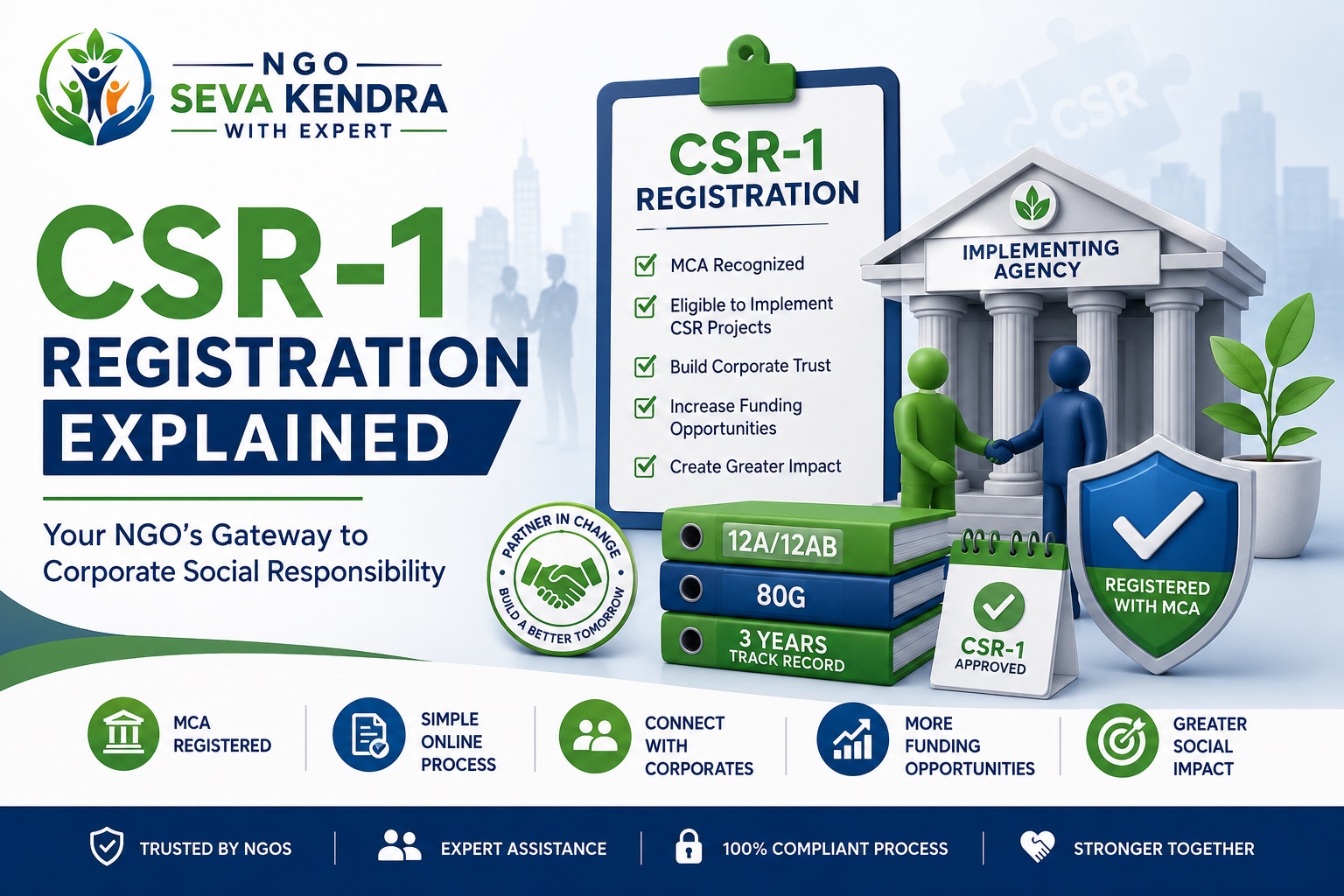
CSR-1 Registration is an important compliance requirement for eligible non-profit organisations that intend to undertake CSR activities as implementing agencies for companies in India. It helps companies identify eligible organisations and promotes greater transparency in the implementation of Corporate Social Responsibility projects.
In this complete guide, learn what CSR-1 Registration is, who is eligible, what documents are required, how the registration process works, applicable government fees, timelines, benefits and common mistakes to avoid.
Quick Summary
If you are planning to receive or implement CSR-funded projects through your NGO, understanding CSR-1 registration is important.
In this guide, you will learn:
✓ What CSR-1 Registration means
✓ Who is eligible to register
✓ 12A/80G requirements
✓ Three-year track record requirement
✓ Documents required
✓ Step-by-step CSR-1 registration process
✓ Professional certification requirements
✓ Government fees
✓ Registration timeline
✓ Benefits of CSR-1 Registration
✓ Common mistakes to avoid
✓ Frequently Asked Questions
INTRODUCTION
Corporate Social Responsibility has become an important part of the social development ecosystem in India. Companies covered under the CSR provisions of the Companies Act, 2013 may undertake CSR activities themselves or through eligible implementing agencies.
For NGOs and other non-profit organisations, CSR funding can provide an opportunity to undertake larger and more structured social-impact projects. However, organisations seeking to act as eligible implementing agencies must satisfy the applicable requirements under the Companies (CSR Policy) Rules, 2014.
One of the important requirements is CSR-1 Registration with the Ministry of Corporate Affairs (MCA).
CSR-1 is not the same as NGO registration, 12A registration or 80G registration. It is a separate registration connected specifically with undertaking CSR activities as an implementing agency.
In this guide, we explain the CSR-1 Registration process in simple language so that NGOs, Trusts, Societies and Section 8 Companies can understand the requirements before applying.
WHAT IS CSR-1 REGISTRATION?
CSR-1 is an electronic registration process prescribed under the Companies (CSR Policy) Rules, 2014 for eligible entities intending to undertake CSR activities as implementing agencies.
The registration is made through the Ministry of Corporate Affairs (MCA) and is intended to create a formal database of organisations that may undertake CSR activities for companies.
After successful submission of Form CSR-1, a unique CSR Registration Number is generated by the MCA system.
The registration mechanism also helps improve transparency and accountability in the CSR ecosystem by enabling companies to identify suitable implementing agencies.
Important:
CSR-1 should not be confused with:
- NGO Registration
- Trust Registration
- Society Registration
- Section 8 Company Registration
- 12A/12AB Registration
- 80G Registration
- NGO DARPAN Registration
Each registration serves a different purpose.
Who Should Register for CSR-1?
CSR-1 is relevant to eligible entities that intend to undertake CSR activities on behalf of companies.
Depending on the applicable category under the CSR Rules, eligible implementing agencies may include:
- Section 8 Companies
- Registered Public Trusts
- Registered Societies
- Certain entities established by the Central or State Government
- Entities established under an Act of Parliament or State Legislature
For independent NGOs falling under the relevant category, the applicable tax registrations and track-record requirements must also be satisfied.
Important clarification
Not every organisation automatically qualifies merely because it is registered as an NGO.
Eligibility depends on the organisation’s legal structure, registrations, establishment status and the applicable provisions of Rule 4.
ELIGIBILITY FOR CSR-1 REGISTRATION
The eligibility requirements can vary depending on how the implementing agency was established.
| Eligibility Factor | Requirement |
|---|---|
| Legal Structure | Section 8 Company, Registered Public Trust or Registered Society, as applicable |
| 12A/12AB | Applicable tax registration required for relevant private implementing agencies |
| 80G | Applicable tax registration required for relevant private implementing agencies |
| Track Record | At least 3 years of established track record in undertaking similar activities for entities covered by the relevant rule |
| Digital Signature | Required for electronic filing |
| Professional Verification | Form CSR-1 must be digitally verified by a practising CA, CS or Cost Accountant |
| MCA Filing | Form CSR-1 is filed electronically with the MCA |
The MCA rules specifically provide a three-year established track record requirement for the category of Section 8 companies, registered public trusts and registered societies covered under Rule 4(1)(d), while certain government-established or statutory entities fall under separate categories.
Important
The three-year requirement should not be presented as a blanket rule for every possible CSR implementing entity. The applicable category needs to be checked before filing.
DOCUMENTS REQUIRED
Documents Required for CSR-1 Registration
Before starting the CSR-1 filing process, keep the relevant organisational and authorised-person details ready.
Commonly Required Information and Documents
1. Organisation Registration Certificate
Proof of registration of the:
- Trust
- Society
- Section 8 Company
as applicable.
2. PAN Card of the Organisation
A valid PAN of the organisation is required for the registration and verification process.
3. 12A/12AB Registration
Applicable income-tax registration details for eligible private implementing agencies.
4. 80G Registration
Applicable 80G registration/approval details.
5. Organisation Details
Keep the following information ready:
- Registered office address
- Email address
- Mobile number
- Registration details
- PAN details
6. Authorised Person’s Details
Details of the authorised director, trustee, office bearer or other authorised representative, depending on the organisation type.
7. Digital Signature Certificate
The required authorised person must have an appropriate Digital Signature Certificate for electronic filing.
8. Professional Verification
Form CSR-1 is digitally verified by a practising:
- Chartered Accountant
- Company Secretary
- Cost Accountant
as prescribed under the CSR Rules.
CSR-1 REGISTRATION PROCESS
Step-by-Step CSR-1 Registration Process
The CSR-1 registration process is completed electronically through the MCA system.
Step 1 — Check Eligibility
First, determine whether your organisation falls under an eligible category for CSR implementation.
Check:
- Legal structure
- 12A/12AB status
- 80G status
- Track record, where applicable
- Other applicable requirements
Step 2 — Prepare Documents
Collect the organisation’s registration documents, PAN, applicable tax-registration details and authorised person’s information.
Step 3 — Arrange Digital Signature
Ensure that the relevant authorised person has a valid Digital Signature Certificate.
Step 4 — Prepare Form CSR-1
Enter the required organisational and authorised-person information in the CSR-1 form.
Step 5 — Professional Verification
The form is digitally verified by a practising CA, CS or Cost Accountant as prescribed under the rules.
Step 6 — Submit the Form
Submit the completed CSR-1 electronically through the MCA system.
Step 7 — Receive CSR Registration Number
After successful submission/processing, the system generates a unique CSR Registration Number.
Step 8 — Maintain Your Compliance
CSR-1 should be viewed as part of the NGO’s broader compliance and CSR-readiness framework. Keep your organisational information, tax registrations and statutory records properly maintained.
Benefits of CSR-1 Registration for NGOs
CSR-1 registration can provide several important advantages to eligible NGOs seeking to participate in CSR-funded projects.
1. CSR Funding Readiness
CSR-1 registration is an important requirement for eligible implementing agencies undertaking CSR activities for companies.
2. Better Corporate Credibility
A properly registered organisation can demonstrate that it has completed the relevant CSR registration process with MCA.
3. Greater Transparency
CSR-1 supports the government’s objective of creating greater transparency and accountability within the CSR implementation ecosystem.
4. Corporate Partnerships
Organisations can approach companies and CSR teams for suitable CSR project opportunities, subject to the company’s due diligence and project requirements.
5. Better Organisational Preparedness
Completing CSR-1 encourages NGOs to maintain important organisational and compliance records.
6. Supports Long-Term CSR Opportunities
A compliant and well-documented organisation can be better positioned to build long-term relationships with companies, foundations and other institutional partners.
GOVERNMENT FEES
What is the Government Fee for CSR-1 Registration?
Government filing fee for Form CSR-1: Generally Nil.
However, this does not mean the entire process necessarily costs nothing.
An organisation may incur expenses for:
- Digital Signature Certificate
- Professional certification
- Documentation
- Professional assistance
- Other applicable compliance services
Therefore, NGOs should clearly distinguish between government filing fees and professional/service charges.
Current professional sources consistently report that MCA does not charge a government filing fee for CSR-1.
Important: Government fees and portal requirements can change. Always verify the applicable MCA requirements at the time of filing.
REGISTRATION TIMELINE
How Long Does CSR-1 Registration Take?
CSR-1 is an electronic filing and, when the organisation is eligible and the information and digital signatures are correct, processing can be relatively quick.
However, the total time depends on:
- Document readiness
- DSC availability
- Correctness of organisation details
- Professional verification
- MCA processing
- Any errors or discrepancies in the submitted information
Typical Practical Timeline
| Stage | Approximate Time |
|---|---|
| Document Collection | 1–2 Working Days |
| Eligibility & Document Verification | 1 Working Day |
| Form Preparation | 1 Working Day |
| Professional Verification | 1 Working Day |
| MCA Submission & Processing | Depends on system processing |
| Overall Practical Timeline | Usually a few working days when everything is ready |
Do not promise a fixed approval time to clients. The actual processing time can vary.
COMMON MISTAKES
Common Mistakes to Avoid During CSR-1 Registration
Mistake 1 — Assuming Every NGO Is Automatically Eligible
Simply having an NGO registration does not automatically satisfy every CSR-1 requirement.
Mistake 2 — Ignoring 12A/12AB and 80G Requirements
Applicable tax registrations should be checked before proceeding.
Mistake 3 — Misunderstanding the Three-Year Track Record
The three-year track-record requirement applies to the relevant category under the CSR Rules and should not be incorrectly treated as a universal requirement for every entity.
Mistake 4 — Incorrect Organisation Details
Even small differences in:
- Name
- PAN
- Registration number
- Address
- Authorised person’s information
can create verification issues.
Mistake 5 — Expired or Invalid DSC
The Digital Signature must be valid and properly associated with the authorised person.
Mistake 6 — Incorrect Professional Verification
CSR-1 requires digital verification by a practising CA, CS or Cost Accountant.
Mistake 7 — Treating CSR-1 as the Same as 80G
CSR-1 and 80G serve completely different purposes.
Mistake 8 — Thinking CSR-1 Guarantees CSR Funding
CSR-1 registration does not guarantee that a company will provide CSR funding.
Companies may independently evaluate an NGO based on:
- Track record
- Project proposal
- Impact
- Governance
- Financial records
- Geographic reach
- Cause area
- Compliance
- Due diligence
CSR-1 VS 12A/12AB VS 80G
Understanding the Difference
Many NGOs confuse these registrations.
| Registration | Main Purpose |
|---|---|
| NGO / Trust / Society / Section 8 Registration | Gives the organisation its legal structure |
| 12A/12AB | Provides applicable income-tax registration/exemption framework for eligible charitable entities |
| 80G | Enables eligible donors to claim applicable tax benefits on qualifying donations |
| CSR-1 | Registration for eligible entities intending to undertake CSR activities as implementing agencies |
| NGO DARPAN | Government platform registration/ID used for specified government and institutional interactions |
Simple Example
Think of it this way:
NGO Registration → Creates the organisation
12A/12AB → Tax-exemption framework
80G → Donor tax-benefit framework
CSR-1 → CSR implementation registration
This distinction is extremely useful for new NGOs.
FREQUENTLY ASKED QUESTIONS
Frequently Asked Questions About CSR-1 Registration
1. Is CSR-1 registration mandatory for every NGO?
No. CSR-1 is relevant to entities that intend to undertake CSR activities as implementing agencies and fall within the eligible categories under the CSR Rules.
2. Can a Trust apply for CSR-1?
Yes, a registered public trust can fall within the eligible categories, subject to the applicable requirements under Rule 4.
3. Can a Society apply for CSR-1?
Yes. A registered society can be eligible subject to the applicable CSR Rules and requirements.
4. Can a Section 8 Company apply for CSR-1?
Yes. Section 8 Companies can fall within the eligible implementing-agency categories subject to the applicable requirements.
5. Is 12A/12AB required for CSR-1?
For relevant private implementing agencies covered by the applicable CSR Rules, income-tax registration requirements such as 12A/12AB and 80G need to be satisfied. Certain government-established or statutory entities fall under different categories.
6. Is 80G required for CSR-1?
For the relevant private implementing-agency categories under Rule 4, 80G is part of the prescribed eligibility requirements.
7. Is a three-year track record compulsory?
A three-year established track record in undertaking similar activities applies to the category specified under Rule 4(1)(d). It is not a blanket requirement for every type of entity listed under Rule 4.
8. Is there any government fee for CSR-1?
There is currently no government filing fee reported for Form CSR-1. Professional or other associated costs may still apply.
9. Who verifies Form CSR-1?
Form CSR-1 is digitally verified by a practising Chartered Accountant, Company Secretary or Cost Accountant.
10. What is the CSR Registration Number?
After successful submission, the MCA system generates a unique CSR Registration Number for the registered implementing agency.
11. Does CSR-1 registration guarantee CSR funding?
No. CSR-1 makes an eligible organisation compliant with the applicable registration requirement, but companies independently select implementing agencies based on their CSR policies, projects and due diligence.
12. Can a newly established NGO immediately receive CSR funding?
Eligibility depends on the organisation’s category and applicable CSR Rules. Independent entities covered under the three-year track-record provision need to satisfy that requirement before undertaking CSR activities in that capacity.
RELATED SERVICES
Related NGO Services
If you are preparing your NGO for CSR funding, the following registrations and services may also be relevant:
Section 8 Company Registration
For establishing a professionally structured non-profit company.
Trust Registration
For establishing a charitable trust.
Society Registration
For establishing a non-profit association under the applicable law.
12A/12AB Registration
For the applicable income-tax registration/exemption framework.
80G Registration
For enabling eligible donors to claim applicable tax benefits.
NGO DARPAN Registration
For registration on the NITI Aayog NGO DARPAN platform where applicable.
Digital Signature Certificate
Required for various online statutory filings.
NGO Annual Compliance
For maintaining proper statutory and regulatory compliance after registration.