
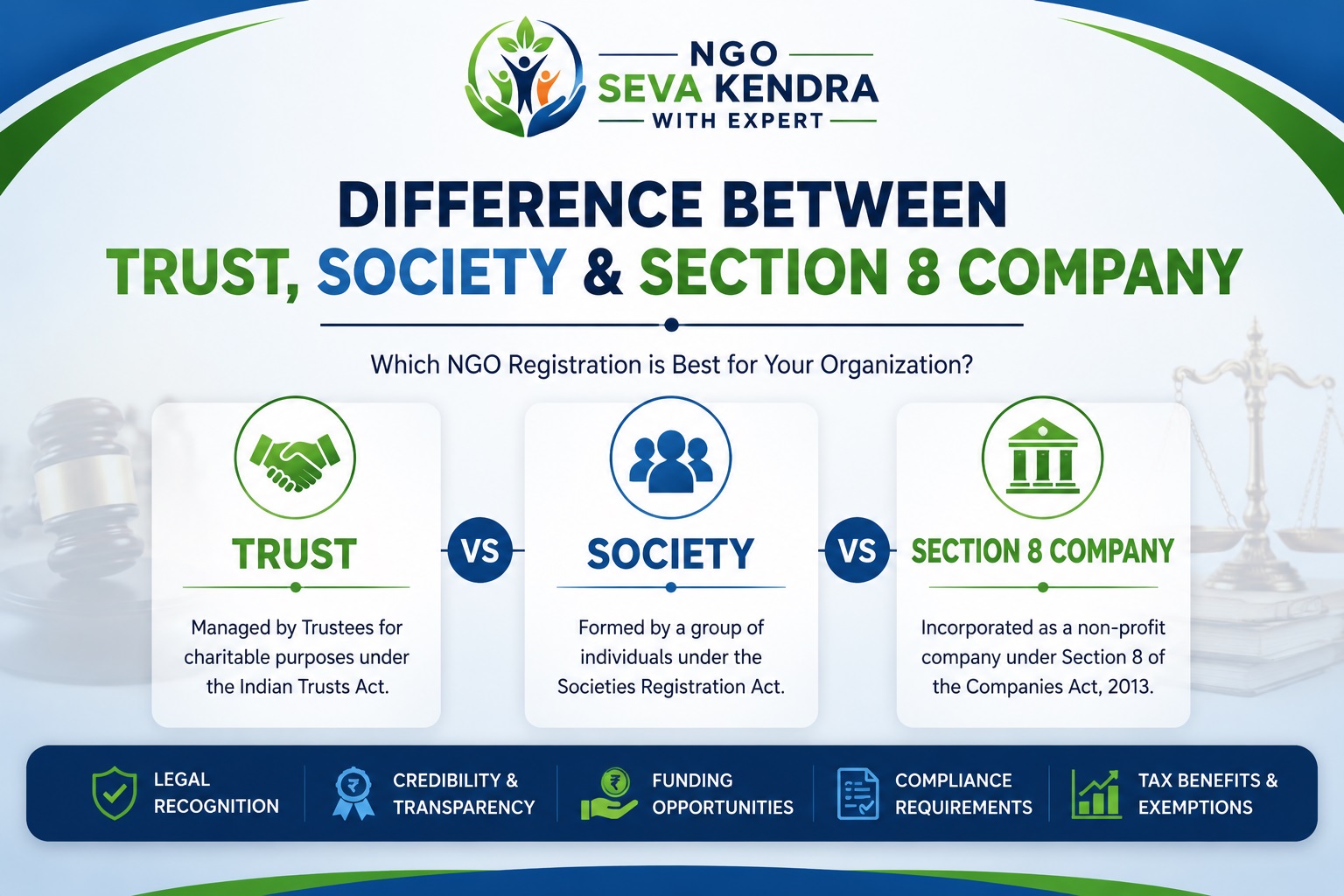
Which NGO Registration is Best for Your Organization?
Understand the differences between Trust Registration, Society Registration, and Section 8 Company Registration based on legal structure, management, compliance, funding opportunities, tax benefits, and credibility.
Quick Summary
- Best for Family Charitable Trusts → Trust
- Best for Membership Organizations → Society
- Best for CSR Funding & Large NGOs → Section 8 Company
- Lowest Compliance → Trust
- Highest Credibility → Section 8 Company
- Government Recognition → Section 8 Company
Introduction
Choosing the right legal structure is one of the most important decisions when starting an NGO in India. The three most popular registration options are Trust Registration, Society Registration, and Section 8 Company Registration.
Each structure has different rules, benefits, compliance requirements, management systems, and funding opportunities. Selecting the wrong structure may create unnecessary legal complications in the future.
In this guide, we compare all three NGO registration types to help you choose the best option based on your objectives.
What is a Trust?
A Trust is created when one or more trustees hold property or assets for charitable purposes. Trusts are governed by the Indian Trusts Act (for private trusts) or respective State Public Trust Acts for charitable trusts.
Trust Registration is generally preferred by family-managed charitable organizations.
What is a Society?
A Society is formed by a group of individuals working together towards charitable, educational, literary, scientific, religious, or cultural objectives.
Societies are registered under the Societies Registration Act, 1860.
What is a Section 8 Company?
A Section 8 Company is a non-profit company incorporated under the Companies Act, 2013. Unlike ordinary companies, its profits cannot be distributed among members and must be used only for charitable purposes.
Section 8 Companies are considered the most credible NGO structure in India.
Comparison Table
Feature | Trust | Society | Section 8 Company |
Governing Law | Trust Act | Societies Registration Act | Companies Act 2013 |
Minimum Members | 2 | 7 | 2 Directors + 2 Members |
Governing Body | Trustees | Managing Committee | Board of Directors |
Separate Legal Entity | Limited | Limited | Yes |
Government Recognition | Medium | Good | Excellent |
Credibility | Good | Better | Highest |
CSR Funding | Limited | Good | Excellent |
Foreign Funding (FCRA) | Yes | Yes | Yes |
Tax Exemption | Yes | Yes | Yes |
Annual Compliance | Low | Medium | High |
Best For | Family NGO | Community NGO | Professional NGO |
Detailed Comparison
1. Legal Structure
A Trust is governed by trustees, while a Society is managed by elected members. A Section 8 Company functions like a corporate entity with directors.
Winner:
Section 8 Company
2. Registration Process
Trust Registration is the easiest.
Society Registration requires at least seven members.
Section 8 Company involves approval from the Ministry of Corporate Affairs.
Winner:
Trust Registration
3. Credibility
Funding agencies, CSR companies, and government departments generally prefer Section 8 Companies because they follow corporate governance standards.
Winner:
Section 8 Company
3. Compliance
Trusts have comparatively fewer compliance requirements.
Section 8 Companies must comply with MCA filings, annual returns, and board meetings.
Winner:
Trust
5. Funding Opportunities
All NGO structures can receive donations.
However, Section 8 Companies generally receive greater CSR funding because of their transparency.
Winner:
Section 8 Company
6. Tax Benefits
All three structures can apply for:
- 12A Registration
- 80G Registration
- CSR-1 Registration
- FCRA Registration
Winner:
Tie
7. Ownership
Trusts are generally controlled by trustees.
Societies are democratically managed.
Section 8 Companies are professionally managed by directors.
Which Registration Should You Choose?
Choose Trust Registration if
✔ Family charitable organization
✔ Religious Trust
✔ Temple
✔ Ashram
✔ Small NGO
Choose Society Registration if
- Educational Institution
- Cultural Organization
- Sports Club
- Welfare Association
- Community Group
Choose Section 8 Company if
- Corporate NGO
- CSR Funding
- National Level NGO
- International NGO
- Large Scale Operations
Advantages & Disadvantages
Trust
Advantages
- Easy Registration
- Low Compliance
- Low Cost
Disadvantages
- Less Professional
- Lower Credibility
Society
Advantages
- Democratic Management
- Better Recognition
- Flexible Structure
Disadvantages
- More Members Required
- Moderate Compliance
Section 8 Company
Advantages
- Highest Credibility
- Corporate Structure
- Better CSR Funding
- Professional Governance
Disadvantages
- Higher Compliance
- Slightly Longer Registration Process
Which Structure is Best for CSR Funding?
If your NGO plans to receive CSR contributions from companies, a Section 8 Company is generally the preferred choice due to its higher level of governance, transparency, and compliance.
Common Mistakes While Choosing NGO Registration
- Choosing a Trust only because it is cheaper
- Ignoring annual compliance obligations
- Not planning for future CSR funding
- Selecting the wrong legal structure for long-term goals
- Registering without professional advice
Frequently Asked Questions
Which is better: Trust or Section 8 Company?
A Section 8 Company offers higher credibility, stronger governance, and better opportunities for CSR funding, while a Trust is simpler and has lower compliance.
Which registration is easiest?
Trust Registration is generally the simplest and fastest.
Which NGO registration is best for CSR?
Section 8 Company Registration is usually preferred by corporate CSR donors.
Can a Society apply for 80G?
Yes. A Society can apply for both 12A and 80G Registration after registration.
Can Trusts receive foreign funding?
Yes, after obtaining FCRA Registration and meeting the applicable legal requirements.
Which NGO registration has the least compliance?
Trust Registration generally has the lowest compliance requirements.